Gayle Chong Kwan: The Great Instauration
During April 2026, Gayle Chong Kwan interrogated the history of the scientific canon with a major installation in the Grand Gallery of the National Museum of Scotland for Edinburgh Science Festival. Through a large-scale site-specific sculptural installation, the work reflects on the cultural legacy of science, exploring and rethinking scientific histories through Chong Kwan’s detailed research into scientific artefacts and archives across eight major collections and speaking with communities.
‘The Great Instauration’ is a new work by British artist Gayle Chong Kwan. Through a large-scale site-specific sculptural installation, the work reflects on the cultural legacy of science, exploring and rethinking scientific histories through Chong Kwan’s detailed research into scientific artefacts and archives across eight major collections and speaking with communities. The installation for the Grand Gallery of the National Museum of Scotland, ‘The Great Instauration’, was commissioned by the Edinburgh Science Festival and developed with support from Creative Scotland.

Left: Gayle Chong Kwan at the National Museum of Scotland. Right: A model of an artwork for the installation. Photo credit Alex Howarth
Installed throughout the Grand Gallery, ‘The Great Instauration’ creates an underground, upside-down world filled with forms hanging from railings and columns. Large-scale sculptures of scientific instruments are transformed into fantastical roots, hanging fabrics of the geological strata of Edinburgh with archival and painted images, and steel plinths inscribed with lesser-known histories fill the space. Chong Kwan connects exploitative and extractive histories, the scientific gaze, and roots, upturning the stories that shape our understanding of scientific knowledge and discovery.

Gayle Chong Kwan: The Great Instauration at Edinburgh Science Festival 2026. Photo credit Edinburgh Science Festival, development of work.
For ‘The Great Instauration’, Gayle Chong Kwan has researched the collections in the National Museums Scotland, Wellcome Collection, Wellcome Collection at the Science Museum, Science Museum Collection Centre in Swindon, Royal Botanical Gardens Edinburgh, Surgeons Hall Museum Edinburgh, and community gardens in Edinburgh.
Chong Kwan has explored the history of the scientific canon and the Scientific Enlightenment in Scotland, rethinking science’s stories and reframing who and what gets to be remembered. Chong Kwan’s work focusses in on Scotland’s complex historical connections with slavery, enslaved people, plant and botanical origins of medicine, the University of Edinburgh, medical infirmaries, the advent of geology, and scientific instruments.
Dr Gayle Chong Kwan, Artist, said: “I am truly excited to present ‘The Great Instauration’, an installation in the Grand Gallery of the National Museum of Scotland that explores science as a culturally embedded process shaped by social history, power, and omission. I have been inspired by objects and narratives across multiple collections and museums, the history of the scientific canon, and the Scientific Enlightenment. My research included scientific instruments, the botanical origins of medicine, and Scotland’s historical connections with slavery. I was interested in how we tend to think of the scientific method, scientific instruments, and the Scientific Enlightenment as bringing understanding. I have explored histories connected with the theodolite, microscope, thermometer, clock, chronometer, and the telescope.
The resulting three-dimensional, surreal sculptural and printed works act as forms of resistance. Developed through archival collage and painting, I was inspired by forms from microscopic slides and medical illustrations, and working through two-dimensional forms, redolent of flattened and sliced scientific specimens. The title ‘The Great Instauration’ refers to Francis Bacon’s 17th-century founding text on the scientific method, but this time as a contemporary call to restore and renew perspectives on the complex histories of science.”
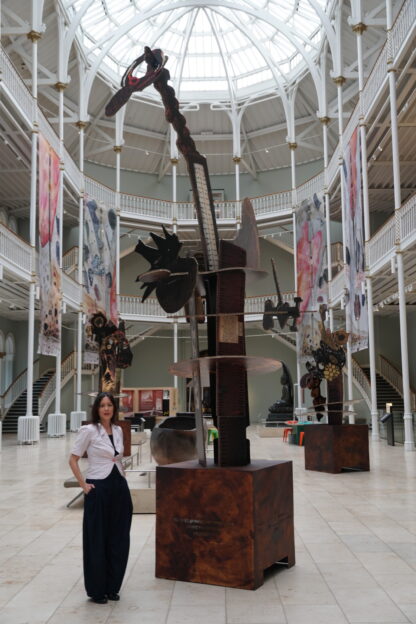
Gayle Chong Kwan ‘The Great Instauration’ 2026. Photo credit – Edinburgh Science Festival
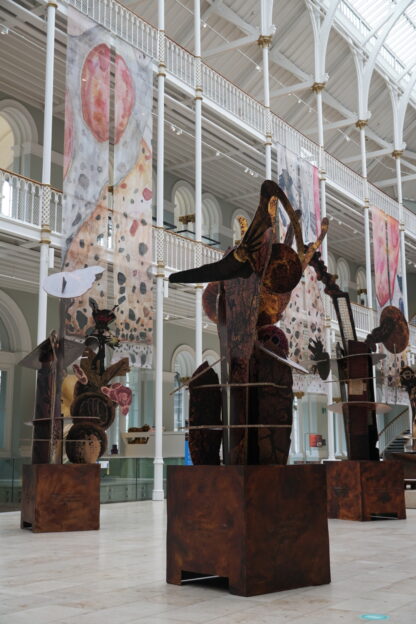
Gayle Chong Kwan ‘The Great Instauration’ 2026. Photo credit – Edinburgh Science Festival
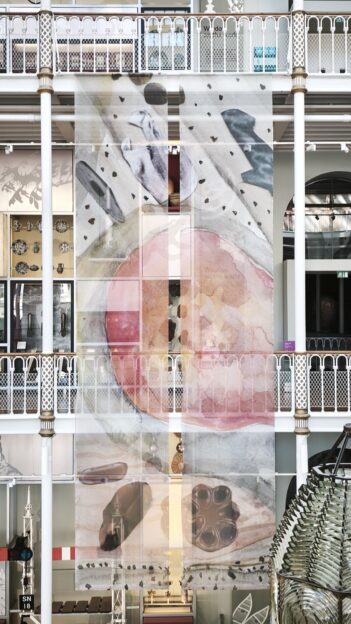
Gayle Chong Kwan ‘The Great Instauration’ 2026. Photo credit – Edinburgh Science Festival
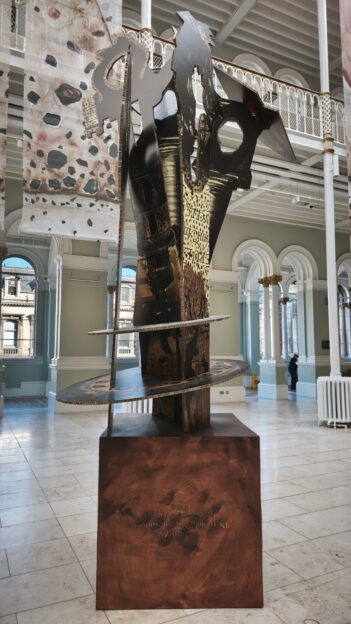
Gayle Chong Kwan ‘The Great Instauration’ 2026, CHRONOMETER. Photo credit – Edinburgh Science Festival
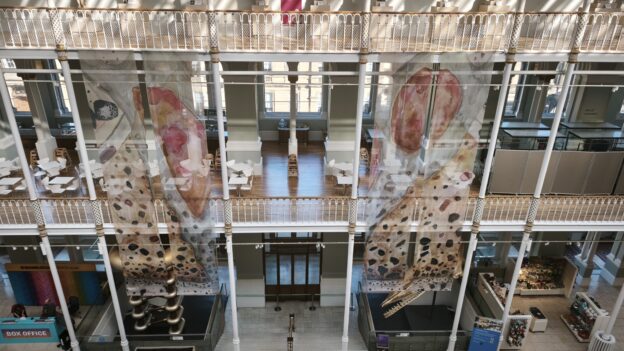
Gayle Chong Kwan ‘The Great Instauration’ 2026., high banners. Photo credit – Edinburgh Science Festival
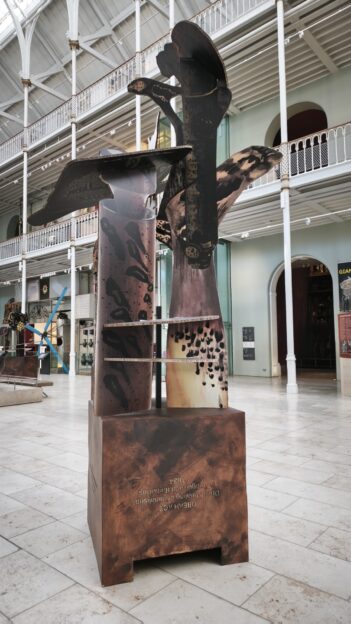
Gayle Chong Kwan ‘The Great Instauration’ 2026., TELESCOPE. Photo credit – Edinburgh Science Festival
The Great Instauration forms part of the wider exhibition Science Under the Lens, where visitors can experiment with some of the instruments which inspired the installation, make their own versions to take home and play with the science of light.
Edinburgh Science Festival is one of Europe’s biggest science festivals and takes over the city during Easter break. This year’s theme, ‘Going Global’, reflects on science as a shared human story: connecting people across countries and continents, joined in scientific breakthroughs and failures, conducting experiments and sharing results. The Festival goes global while also celebrating the local: universities, laboratories, hospitals, schools and cultural spaces.
‘The Great Instauration’ is commissioned by Edinburgh Science, developed with support from Creative Scotland through the Scottish Government’s Festivals Expo Fund, additional funding from the Henry Moore Foundation, and guidance and support from Edinburgh Art Festival, National Museums Scotland, Scottish International Storytelling Festival and Wellcome Collection.
……………………………
About Gayle Chong Kwan
Dr Gayle Chong Kwan is an award-winning British artist (born Edinburgh, of Scottish and Chinese-Mauritian heritage) who works internationally at the intersection of historical, material, and archival research and fine art practice. Her work is known for surreal and fantastical combinations of natural forms, layers, archives, artefacts, food, and waste. She creates large-scale installations, video, XR, performance, and ritual events that explore complex, sensory and unacknowledged histories, the contested nature of collections and ecological degradation.
Recent work includes a wearable virtual reality installation developed as artist in residence at Avebury Neolithic UNESCO World Heritage Site, a script for a ballet using the founding collection of the British Museum. She has made landscapes out of rotting food, created an imaginary island that spans the length of a shopping centre, and transformed a concrete underpass into an immersive cave using 20,000 milk bottles, and worked with neuroscientists and taxi drivers to explore how we navigate our memories.
Exhibitions include ‘I am the Thames and the Thames is Me’, Science Gallery London (2025); ‘The Taotie’, Compton Verney (2024), ‘A Pocket Full of Sand’, John Hansard Gallery (2024); ‘Waste Archipelago’, Venice (2021); ‘Wastescape’, New Zealand (2019);’ The People’s Forest’, William Morris Gallery (2018); ‘The Obsidian Isle’, 54th Venice Biennale (2011); Cockaigne, 10th Havana Biennial, Cuba (2009).
Gayle Chong Kwan draws upon multiple disciplines – a BA Hons in Politics and Modern History from the University of Manchester specialising in Sub-Saharan African Post-Colonial Politics, an MSc in Communication from the University of Stirling, a BA Hons in Fine Art from Central Saint Martins specialising in sculpture, an MA in Information Experience Design from the Royal College of Art working with ritual archaeology and virtual reality, and a PhD in Fine Art from the Royal College of Art on ‘Imaginal Travel: political and ecological positioning as fine art practice’ (2022), which explores interiority and collaboration to ask how art interventions in galleries, museums, and the public realm can question and challenge acquisitions, public participation, and the status of objects and ecologies in which they sit.
Gayle Chong Kwan has been Artist in Residence at Avebury UNESCO World Heritage Site (2024); at the British Museum (2023), and the V&A (2019-2021) during which she developed ‘The Circulating Department’ (2021). She developed Waste Archipelago (2021) with Ca’ Foscari University Venice, as winner of the 2019 Sustainable Art Prize. Memory Trace (2012) for the Wellcome Trust in which she worked with Prof. Eleanor Maguire on the role of the hippocampus in London taxi drivers, from which she created a 44m interactive photographic installation, which changed with day and night and the seasons, to show taxi journeys through London as neural pathways in a surreal landscape of the brain made from historical images from the Wellcome Collection. Quarantine Archipelago (2019), a photographic series that explored quarantine islands in ‘Far Away, Too Close’ exhibition at Tai Kwun Centre for Arts and Heritage in Hong Kong.
Gayle Chong Kwan is a Lecturer at the University of the Arts London, was selected as a BAME BBC Expert in Fine Art, and appears on BBC Radio programmes talking about her projects and research. She is represented by Galerie Alberta Pane.
About Edinburgh Science
Edinburgh Science, founded in 1989, is an educational charity that aims to inspire people of all ages and backgrounds to discover the world around them. The organisation is best known for organising Edinburgh’s annual Science Festival: the world’s first festival of science and technology and still one of Europe’s largest.
The two-week Festival provides wide and diverse audiences with amazing science-themed experiences through an exciting programme of innovative events for families and adults. Alongside the annual Festival in Edinburgh, the organisation delivers a schools touring programme, Generation Science, that brings science to life in classrooms around Scotland, and delivers an annual Careers Hive event which promotes STEM careers to secondary school students.
Additionally, Edinburgh Science runs regular Climate Co-Lab events, to bring together industry, academia and interested organisations to discuss ideas to accelerate our transition to net zero. Over the years, this not-for-profit has also shared expertise worldwide. Edinburgh Science introduced, and for many years led, the Abu Dhabi Science Festival. And more recently, partnered with the Getty Foundation to deliver the Art-Science Family Festival in Los Angeles.
Edinburgh Science Festival 2026 is delivered with support from Principal Funding Partners Creative Scotland, Edina Trust, The City of Edinburgh Council, and the Scottish Government. Major funding is provided with support from Baillie Gifford and Cirrus Logic. Funding Partners are Arup, Association for Science and Discovery Centres, Edinburgh Airport, Henry Moore Foundation, The James Hutton Institute, Consulate General of Italy in Edinburgh and Italian Institute of Culture, Lumo, the National Quantum Computing Centre and SeeByte.
About Creative Scotland
Creative Scotland is the public body that supports culture and creativity across all parts of Scotland, distributing funding provided by the Scottish Government and The National Lottery. Further information at creativescotland.com. Follow Creative Scotland on Facebook, LinkedIn, and Instagram.
EAF (Edinburgh Art Festival) is the UK’s largest annual festival of visual art. Founded in 2004, we work with local and international partners to present an ambitious and meaningful programme of exhibitions, events and projects across the city. Since its beginnings, EAF has featured exhibitions including international and UK artists at a pivotal point in their career alongside the best emerging talent, major survey exhibitions of historic figures, and a programme of newly commissioned artworks that respond to historic sites in the city. We support Scottish and international artists to make new and ambitious projects which engage with the extraordinary context of Edinburgh in August. Presented principally in public spaces, our projects allow access to overlooked or neglected stories or spaces in our city’s heritage. EAF’s year-round civic engagement programme has long-term relationships and partnerships across the city, creating relevant and memorable experiences with artists. We invite local people to explore culture, community, the city and self-expression, and value, with many festival projects reflecting this unique creative relationship.
…………………………………
https://www.gaylechongkwan.com/
Get the Full Experience
Read the rest of this article, and view all articles in full from just £10 for 3 months.
No comments yet.