Reflections on the Evolution of Consciousness
Primarily a visual artist, Paul Forte also writes essays and poetry. Forte’s career as an artist began in the San Francisco Bay Area in the early 1970’s. Influenced early on by Conceptual art, Forte has employed a variety of media over the years to realize ideas, including making and self-publishing artist’s books and related objects.
“An experimental approach to art making coupled with an abiding sense of the poetic are the hallmarks of my art. It is an art that has explored this approach and sensibility through a variety of media and artforms over the years: Word works and poetry, artist’s books and book works, performance art, drawings, collage, montage, and assemblage. Central to much of this work is the use of found or appropriated material.”
One of the main aspects of consciousness is self-consciousness. Its importance was first highlighted by Alan Turing who claimed that a computer could never be the subject of its own thought, as it lacks self-awareness or self-identity. Literally “I” is defined as any means that we use for referring to self and comprises our body, mind, soul, or their combination.1
Human consciousness seems to be one of life’s enduring mysteries. Even if we narrowly define consciousness as a person’s awareness of and reflection upon their being, we are left with the riddle of that very awareness and reflection. What human consciousness does or how it enables human beings to perceive the world is perhaps easier to comprehend than coming to terms with just how it is that we are conscious of our own minds. Even though we might never fully grasp what it means to be conscious, or what it essentially is, sustained self-reflection on or of consciousness might nevertheless deepen the sense of our humanity. In this so-called “post-human” era driven largely by the advancements of Artificial Intelligence, we might benefit from a deeper sense of ourselves and the realization that there are questions about our consciousness that might ultimately have no answers. One thing seems certain: we are not likely to find answers about the nature of consciousness through Artificial Intelligence. Moreover, there is a very real possibility that we might be misled by our enthusiasm for AI given its superior technical abilities, lulling us into believing that our agency as individuals is dependent upon our engagement with these artificial minds.
The first step in this technological seduction is the belief that AI can develop consciousness. In 2022, when a Google engineer publicly claimed the AI model called LaMDA he had been developing appeared to be conscious, Google countered that there was ‘no evidence that LaMDA was sentient (and lots of evidence against it)’.2 There is no evidence either for or against this claim, because we do not understand what consciousness is. Our understanding of this most difficult scientific problem remains elusive; therefore, it stands to reason that we cannot claim that AI is or isn’t conscious. However, some have nevertheless claimed that it is unlikely that machine consciousness can be achieved. To date there are at least 29 theories of consciousness. Referring to one of these, the “Integrated Information Theory,” Christof Koch, writing in the June 2018 issue of Scientific American, states: IIT also predicts that a sophisticated simulation of a human brain running on a digital computer cannot be conscious – even if it can speak in a manner indistinguishable from a human being. Just as simulating the massive gravitational attraction of a black hole does not actually deform spacetime around the computer implementing the astrophysical code, programming for consciousness will never create a conscious computer. Consciousness cannot be computed: it must be built into the structure of the system3. It stands to reason that in order to build consciousness into the system we need to understand what it is. In this context, that we may never solve the riddle of human consciousness might be for the best. What might essentially preserve our humanity is the possibility that the human mind will never fully grasp its dynamic potential, which is always, as it were, one step ahead of itself. This self-transcendence involves the reality of human creativity and imagination, organic qualities that cannot be realized even by the cleverest algorithms. In spite of all our superior engineering (and dreaming), Artificial Intelligence cannot keep up with the human mind, because after all, A.I. is nothing more than a super compiler of data, impersonal, with no sense of itself, no body, no real being. What was true about this technology in Alan Turing’s time remains true today.
The vexing question we are faced with is essentially: can consciousness somehow observe itself? We cannot speak of the evolution of consciousness with any certainty if we fail to grasp its essence. If the nature of consciousness remains a mystery, we cannot be certain if it is evolving, although, that it has evolved is beyond question. And if it has evolved through time, we can only assume that consciousness continues to do so; its evolution can only be inferred. It might be that we can only recognize and understand the means of its evolution but not its essence. And it is here that humanity faces a paradox: the mysteries of life have always been the impetus of human knowledge and understanding, including knowledge and understanding of the human mind. Mystery, it seems, is essentially what drives our need to know and understand ourselves and the world. Human consciousness then seems to be the ultimate paradox: the fundamental mystery of what it is and what sustains it and enables it to evolve is also what confounds it.
The idea that human consciousness is evolving has been in the back of my mind for some time; an idea implicitly suggested over the years and seemingly brought to fruition through my work as a visual artist. To make art certainly requires consciousness, indeed, I regard artmaking as a form or extension of consciousness; a process that gives mental awareness, thoughts, feelings, and perceptions a palpable presence. What primarily distinguishes this form of consciousness is creativity and imagination, essential aspects of any artmaking process. Creativity and imagination are dynamic aspects of consciousness, however, the psychic energy that drives creativity and imagination is not fully a matter of consciousness. If consciousness continues to evolve and creativity and imagination play a role in its evolution, artmaking might reveal something about how this is happening. Moreover, it also seems that artmaking and/or discussions of the processes involved will necessarily involve creative thinking and the role of consciousness in that process.
Speaking as neither a neuroscientist, psychologist, nor a philosopher of mind, but as a creative and reasonably intelligent person capable of sustained self-reflection, I will proffer some lay opinions about the nature of consciousness. Such opinions are necessarily subjective. Subjective viewpoints on this matter might be suspect to the neuroscientist, the underlying assumption being that subjectivity will necessarily limit an objective understanding of consciousness by virtue of coming at it from a singular point of view. Fair enough. But subjectivity might be the key to better understanding how consciousness works. Many creative individuals are more than capable of peering into the folds of their own minds and perhaps discovering, in spite of or perhaps because of their subjectivity, something of the roots of consciousness; an awareness of being leading to a reflection of being. Creative artists often have an advantage over many academically trained specialists researching the nature of the human mind. Our practices are not limited to a theoretical or intellectual understanding of the psyche; we engage with consciousness in concrete ways that question and/or explore its nature.
As my thinking began to mature, an attempt to better understand the cognitive nature of my artwork (including its often-conceptual bearing) led me to reflect upon the underpinnings of cognition. The hard problem of consciousness, or the problem of subjectivity, came to mind through cognitive consciousness, a capacity that I believe is best revealed through artwork. Now, I understand “cognitive consciousness” to mean consciousness of cognition in perceptual terms and by extension, consciousness of oneself in the process of sensing whatever it is that comes to one’s attention, or, if you will, one’s subjectivity. Perceptual learning seems central to a concrete understanding of cognition. The question is: how exactly do we learn from new perceptions? Is such learning based entirely on acquired taste or understanding or does the new perception spark the imagination which in turn leads to an “Aha!” moment and the enhancement or revitalization of cognition? We might all agree that being aware of anything requires a modicum of consciousness. But knowing, understanding, and making judgments about something also requires imagination, which seems greater than awareness alone because in order to make sense of something we often have to fill in gaps in our perception. While sentience or awareness is part of the foundation upon which human beings build knowledge and understanding of themselves and the world, there is more to consciousness than simply how we perceive things.
Self-consciousness is by definition subjective. But our subjectivity need not devolve into solipsism. The world beyond oneself is real; it’s absurd to believe that people and things are merely figments of one’s consciousness. However, our subjectivity is essential to being human, but it is never fully separate from others and the world. What is interesting about the art experience is that very often the figments of another’s consciousness are made “real” through their art; given tangible form in the world. The difficulty arises when we attempt to understand what others make of such subjective imaginings; an attempt that often overlooks what essentially makes us individual perceiving, thinking and feeling beings. In other words, there is no way to fully understand the subjective workings of another’s mind. And yet, an inkling of another’s mind might be had indirectly through some form of expression or communication, which could have some bearing on how consciousness functions. Indirectly observing the workings of another’s consciousness through, for example, their art, can reveal something about our own consciousness. The art holds up a mirror and not only reveals the possibility of intersubjectivity and thus contributes to shared cognitive engagement, this mutual engagement through the work might also further reveal something about consciousness and the possibility of its continued evolution.
To return to the question of consciousness observing itself, I believe that when we are self-conscious, we are paradoxically attempting to function as both the subject and object of our consciousness. And while self-consciousness is constrained by something akin to the “observer effect” of theoretical physics (and more generally); a sustained engagement with art might nevertheless reveal the extent or limitations of self-consciousness, thus nourishing or reviving our cognitive abilities. This is a critical insight into the nature of intersubjectivity and a clue to better understanding the art experience, particularly if that experience is driven by the shared recognition of perceptual factors basic to cognition, e.g., the delineation and shape of objects, the frequency of sounds, or the colors of an image. Our subjectivity often makes us perceive things in ways based upon previous experience, but there are always fundamental aspects of perception that might elude consciousness due to preconceptions. Engaging with art can make us aware of these limitations by inducing reflection on how we actually perceive things; and perhaps even making us think more deeply about consciousness itself and its relation to subjectivity. This raises the possibility of art that approximates a balance between subjective and objective experience, something that might transpire between artist and audience. This seems to be the key to intersubjectivity, certainly in the art experience, but perhaps beyond as well.
The question remains: what are the possible ways that human consciousness might evolve today and into the future? While the evolution of consciousness is likely to continue, perhaps in surprising ways, the very nature of that evolution is, of course, uncertain, unknowable. Nevertheless, creative thinking humans can hazard guesses as to what might happen, provided that we have some inkling of what consciousness might be, as well as how it might continue to evolve, however tentative these conjectures are. One thing does seem certain: human consciousness of itself, or self-consciousness, is at the core of questions regarding the further evolution of our consciousness. It is safe to assume that the focus on self-consciousness, subjectivity and intersubjectivity is the foundation upon which to begin any speculation on how human consciousness might change and grow. If nothing else, this speculation is itself an attempt to deepen an understanding of our own minds. Descartes’s Cogito (“I think, therefore I am”) cannot be the foundation for the difficult question of what consciousness is and how it might evolve. It seems absurd to doubt one’s own existence and then posit that the thought that one exists conclusively determines one’s being. The pressing issue now in the determination of being is not simply a matter of human thought, but moreover involves our bodies and perceptual learning. We are obviously much more than just thinking beings. Our perceptions of the world and ourselves seem fundamental to our consciousness and its continued evolution. Art and the imagination that it can inspire is central to this.
The idea of the “evolution of consciousness” from this perspective or any other is fraught with difficulties. Chief among these is the fact that we do not fully understand the nature of the “agency” or the “I” that defines or seems to make consciousness possible; how it has arisen, its makeup and where it begins or ends. For example, does a vestige of this agency of consciousness remain during dreaming? When you dream, some strange form of consciousness persists, even if its disconnected from the outside world.4 This strange, internalized consciousness is a kind of self-reflection with roots in the unconscious, both personal and collective. From the perspective of wakefulness, dreaming seems a shading of consciousness into unconsciousness. When we experience dreaming is it this agency that is doing the “observing,” much like an audience of one in a darkened theater? Any discussion of the evolution of consciousness seems mired from the beginning in uncertainty and, again, raises more questions than answers. If the condition of being aware, sometimes held to be synonymous with consciousness, is a neurophysiological experience, whereas consciousness proper entails something more than experience in this sense, and is somehow awareness plus agency, then, again, just what is this agency? A Cartesian homunculus?
In all seriousness, whatever consciousness is, or however we come to understand it (which will, of course, affect how we think about ourselves and others), that consciousness has evolved over the past few hundred thousand years seems a reasonable assumption. The archeological record seems to infer as much and supports this contention. It is therefore logical to assume that since consciousness has evolved in the past it will likely continue to evolve in the present and into the future. The evolution of consciousness is also suggested on a personal level. Who among us does not believe that we change behavior, habits, beliefs, and so forth over a lifetime, often over and over. We believe that our consciousness has evolved. There is usually some core self-identity that remains, but very often we are in many ways not the same person that we were in years past. Of course, the consciousness of human beings evolves in very different ways based on many factors: environmental influences, intellectual capacity, education, social and economic status, and a host of other variables. The point is that all humans undergo this process of change in various ways over their lifetimes.
The evolution of human consciousness involves its growth or expansion. The physical brain of our species has undergone enormous changes over thousands of millennia. A primitive mind, or ancient brain (the cerebellum) probably began forming as early as our hominin ancestors. By the time modern humans arrived on the scene a few hundred thousand years ago, the primitive mind had either begun to evolve more slowly or even stopped evolving altogether, preserving instinct, among other things. Consciousness as basic awareness, for example, of bodily functions, probably emanates from what psychiatrist Derek Steinberg calls the primitive or “archetypal mind.” In this context Steinberg has something important to say about this primitive aspect of mind and the role of art in the evolution of consciousness:
There is no reason to suppose that the basic, archetypal mind, down to its roots in the neural network and the unconscious, has changed much over millions of years; consciousness, however, is still unfolding from it, as old mind speaks to new mind across space and time, new minds generate art, and art continues to shape and expand consciousness.5
How art continues to shape and expand consciousness seems to involve the reciprocity of engaging with art and the perceptions, imaginings, thoughts, and feelings as a result of that engagement, or as Steinberg puts it how: mind generates art and art feeds mind. 6 This suggests the potential of art in terms of the evolution of consciousness for both the makers of art and its audience. Our subjectivity and intersubjectivity might be the saving grace of our species. Art and art making are thus essential to the preservation of our humanity, particularly in light of the growing power of new technologies. If human consciousness continues to evolve, artists seem to be in the vanguard of this evolution.
- Ashkan Farhadi, “The Evolution of Consciousness Theories,” Qeios online research article, January 2024.
- Allison Parshall, “The Hardest Problem,” Scientific American, February 2026, 35.
- Christof Koch, “What is Consciousness?”, Scientific American, June 2018, 13.
- Allison Parshall, Ibid., 29.
- Derek Steinberg, “Consciousness Reconnected, missing links between self, neuroscience, psychology and the arts, Radcliff, 2006, 138.
- Derek Steinberg, Ibid., 119
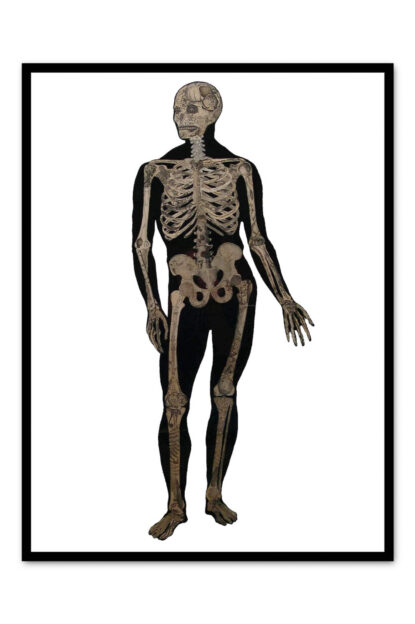
Vegetal Man 2005
Collage over medical chart & enamel on board, 34 x 49 inches.
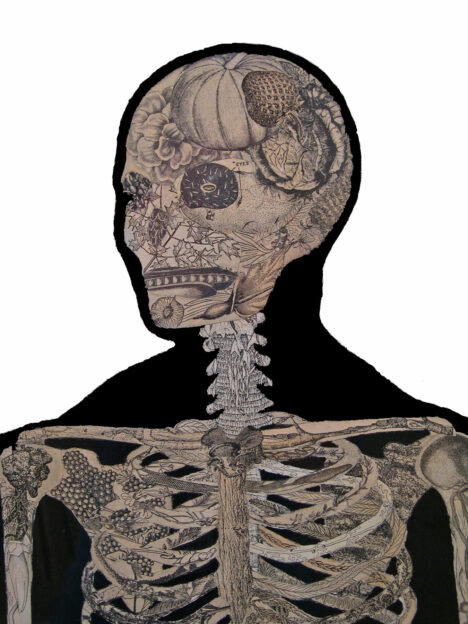
Vegetal Man 2005 (detail)
Collage over medical chart & enamel on board, 34 x 49 inches.
The plant kingdom and the animal kingdom seem worlds apart. But the division between these realms is in fact illusory, as nearly all higher order animals, including humans, host an abundance of microscopic flora as well as fauna. Fully understanding our relationship to the natural world involves the recognition of our interdependence with it. Vegetal Man is meant to symbolize that interdependence. This large collage is made of fragments of a wide variety of plant and fungi illustrations selected from botanical books and other sources. The illustrations making up the collage are layered over an enlarged illustration of a human skeleton and various plant, and fungi shapes were selected to approximate the morphology of the bones. In addition to this the illustrations were also selected to suggest a rough chronology: beginning at the feet are the most primitive flora; lichens, mushrooms, and ferns, ascending through herbs, wild berries, and woody plants to culminate in cultivated flowers, fruits and vegetables in the head of the figure.
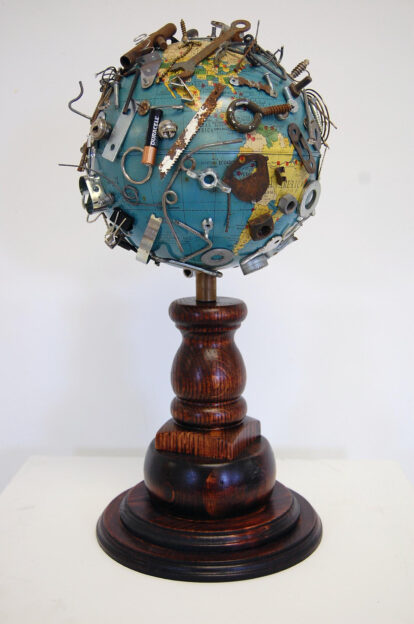
Small World (2008)
Magnetized steel globe with metal objects on Oak base, 20 x 12.5 x 12.5 inches.
Small World is an assemblage made from a little steel globe imprinted with oceans and continents and festooned with various metal objects: rusty nails, wires, nuts and bolts, springs, and so forth. This suggests an unfortunate fact: the enormous amount of space debris in low earth orbit. The objects are held in place by hundreds of little round magnets lining the inside of the globe, an elegant solution to the problem of how to attach the objects to the metal sphere that also suggests another fact about the planet: that the earth has a magnetic core.
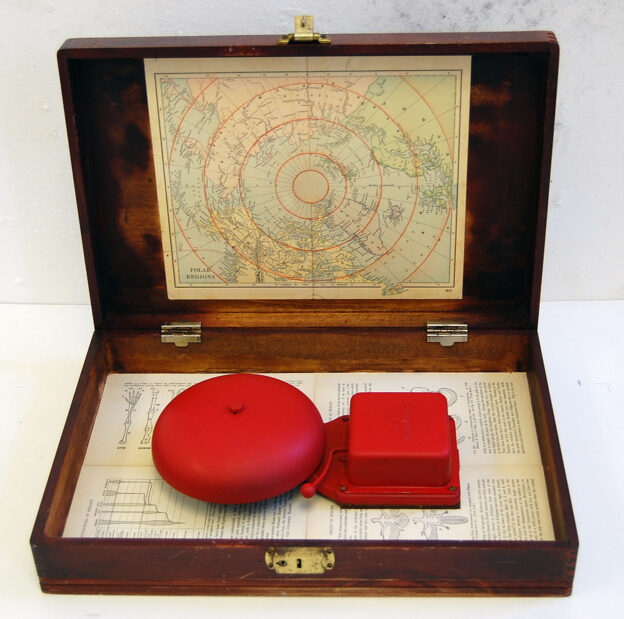
Ringing Silence (2012)
Painted alarm bell, map, biology textbook pages in wood case, 13.5 x 16.75 x 12.5 inches.
Ringing Silence carries a warning concerning the precarious state of the world as a result of climate change. The work, a small found case outfitted with a red alarm bell, a map of the arctic (with lines of latitude emphasized in red), and biology textbook pages discussing the origin of the species, is unequivocal. Ringing Silence raises a palpable warning about the heating of the planet, and by virtue of its title also suggests the dark possibility of that old adage: “out of sight, out of mind.” While few of us will ever find ourselves in the arctic witnessing disappearing ice, as time goes on, we will certainly experience more and more of the effects of a warming planet in terms of intense weather events, coastal flooding, raging forest fires, and other calamities.
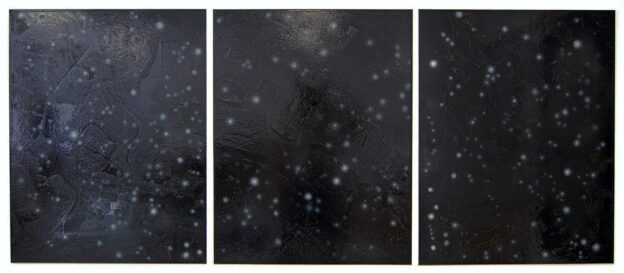
Panspermian Nocturne (2014)
Enamel and texture medium over mounted photocopies, triptych, 79.5 x 33.5 inches.
Panspermian Nocturne is a mixed-media triptych based on three enlarged photocopies of aerial photographs of the earth’s surface. The large photocopies were glued on panels, their topographical features carefully texturized with gel medium, which upon drying built a series of low reliefs that were subsequently painted over with gloss black enamel. Little orbs of white paint based on stencils of Northern hemisphere constellations (from1886) were added to the pitch-black relief images of the earth’s surface, suggesting both terrestrial habitation and floating spores. The work can be interpreted as a lyrical illustration of a hypothesis that has been around since the time of the Greek philosopher, Anaxagoras. Panspermia is the hypothesis that life exists throughout the universe and can be transported between far flung planets and moons via asteroids and comets. In spite of its antiquity it remains a contentious hypothesis, fueled by a dearth of scientific evidence. If the interstellar or intergalactic transportation of microorganisms is possible, it is probably accidental (simply the result of planetary ejecta, and so forth). In any event, the sustainability of these organisms in space rests with the roles that radiation pressure, atmospheric entry and other factors might play in the survival of these organisms, as well as the more fundamental question about the nature of life itself.
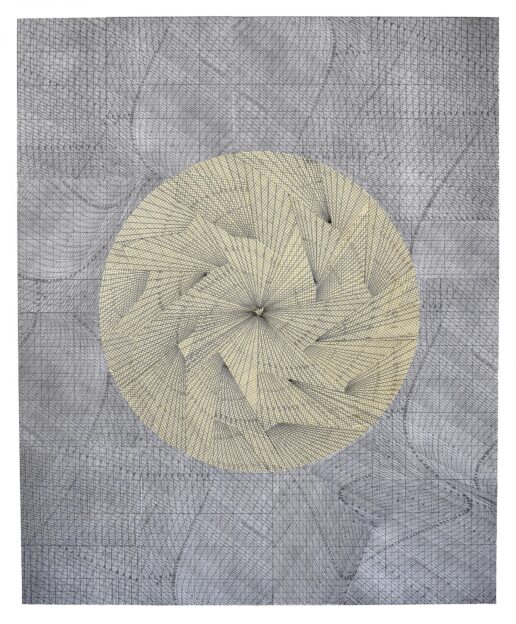
Engine (2016)
Collage on board, 31.5 x 38 inches.
Engine is a “visual/conceptual abstraction” constructed from data charts of the thermodynamic properties of steam, including solid and liquid phases, published in the 1940s. This data, originally produced on fold out sheets in a book by two professors (of mechanical engineering and physical chemistry) has been reconfigured into a mysterious yellow circular object embedded in a distorted grid suggesting the fluctuations of gravity. This dynamic object and its surrounding grid represent a kind of “theorem” symbolizing the energy of the mind. From a physical point of view mental states are the result of heat produced by the interaction of chemical and electrical energy. But mind and consciousness cannot stem questions as to their nature when reduced to epiphenomena of the brain, one result of a physicalist frame of mind. Engine repurposes data concerning a physical process to construct an imaginative picture of the mind, consciousness, or mental energy. The work also seems to imply the sublime nature of mathematics, physics, or even physical reality. Engine, then, is an image that is both concrete and abstract, rational and irrational, real and unreal, and suggests that the nature of mind and consciousness are ultimately unknowable, a mystery.
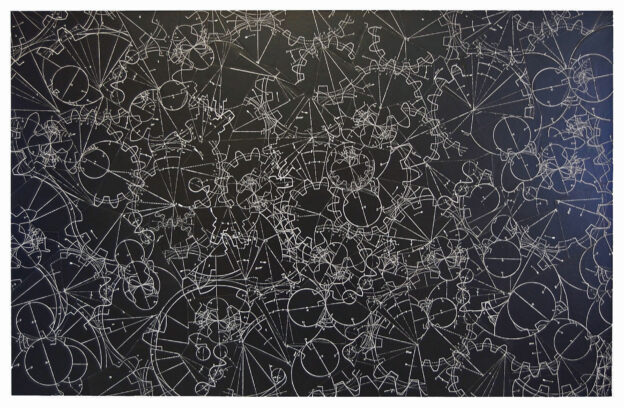
Dark Web (Machinations) 2018
Photocopies on board, 40 x 60 inches.
Dark Web is a large collage made from about a dozen diagrams of gear mechanisms, reproduced in quantity and enlarged and printed in negative. The photocopies were then cut into parts and arbitrarily reassembled. The work refers to a troubling aspect of contemporary life by way of a visual metaphor. The title of the work alerts the viewer to this referential aspect and is in keeping with the visually intricate, almost diaphanous web of white lines that make for a bewildering, overlapping network. “Dark Web” is, of course, the term for that part of the internet where irrational, illicit, and even criminal activity festers. In a sense, it is the sinister, dark chaotic underside of the brave new digital world, perhaps akin to the human unconscious.
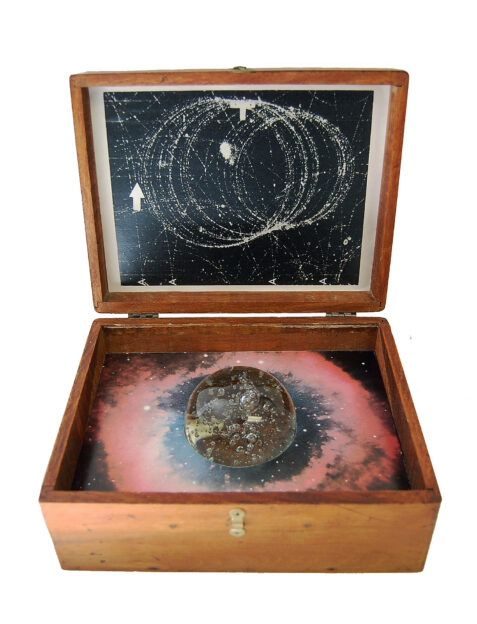
Cosmic Riddle (2018)
Glass globe (with bubbles) set into a telescopic photo of a supernova, with a cloud chamber image on the inside lid of a wood box, 10×9 x 6.5 inches.
Cosmic Riddle is an assemblage that might suggest a “poetry of theoretical physics” and the mysterious (quantum?) connection between the microcosm and the macrocosm. The glass sphere of gases frozen in time also seems to symbolize a peculiar result of relativity theory: that at the speed of light time comes to a standstill. An infinitesimally brief moment in time is also represented by the black and white image of subatomic particle tracks in a cloud chamber.
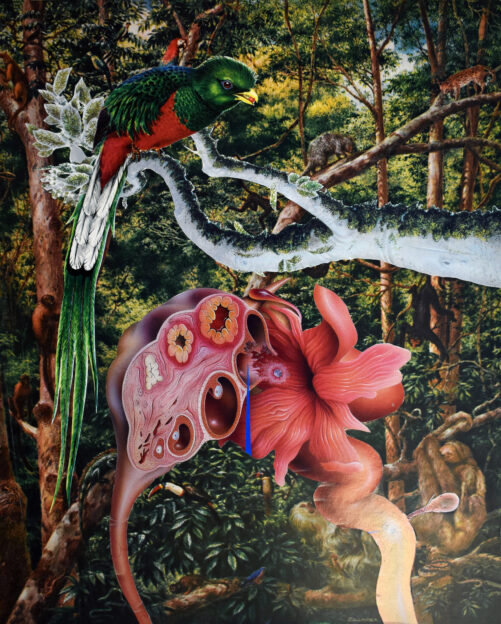
Swollen Seed 2020
Illustrations on book page on board, 10 x 11 3/8 inches.
It waits expectantly for a seed, delivered under a torrid umbrella of flashing shapes & showering whoops, whistles, and screeches in seething columns of filtered light. From the forest floor, a fleshy bloom oozing nectar & trembling with anticipation, flaring with fragrance and nourishing the laden air. In the distance, rumbling exhausts of power marching day and night, crushing limbs & wings, leaving chasms of silence. A bitter seed held in a passing beak above a strange orchid reaching from an ancient, decayed carpet, its green promise slipping away, evaporating in the heart of burned clearings of mineral ash.
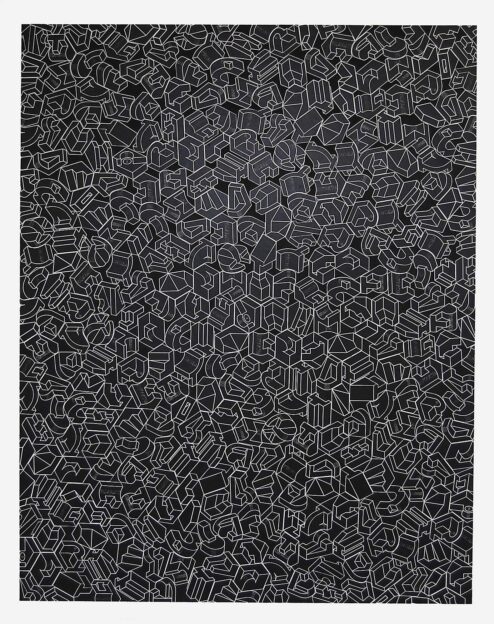
Lewitt’s Puzzle 2015
Collage, enamel on board, 33 x 40.5 inches
Leafing through a mechanical drawing textbook published in the 1940s a few years ago, I came across a series of small drawing exercises that reminded me of an early work of conceptual artist, Sol Lewitt: his black and white photos of incomplete open cubes from 1974. Lewitt took a cube and systematically reduced it to all the variations of its linear components. He then had the variations fabricated in wood, painted and individually photographed, producing a series of structures in white on black backgrounds. The Incomplete Open Cubes reveals a concern with space and volume in both perceptual and conceptual terms, and the black and white photos of these structures are similar to those drawing exercises in the textbook, which tested the draftsman’s ability represent volume through simple linear shapes. With Lewitt’s Puzzle I appropriated the small textbook drawings and then printed them enlarged and in negative, carefully cutting out and fitting the copies together like pieces of a puzzle. The process of puzzling the pieces together was to a large extent arbitrary, but as the “puzzle” came together it began to take on an optical quality. Working from the center out, I soon realized that the pattern produced by the shapes was becoming visually vibrant; a pattern that transmitted energy. Lewitt’s Puzzle, initially conceived as a playful conceptual tribute to Sol Lewitt, eventually led to a puzzling question regarding Lewitt’s take on the limits of creative intuition.
This limitation is summed up by Lewitt in Sentences On Conceptual Art from 1969: “28. Once the idea of the piece is established in the artist’s mind and the final form is decided, the process is carried out blindly. There are many side-effects that the artist cannot imagine. These may be used as ideas for new works.” The optical nature of Lewitt’s Puzzle is more than just a “side-effect,” it is an integral part of the piece guided by an intuitive sense of composition. Lewitt maintained that aesthetic ideas spring from the artist’s intuition, however, the process of intuition need not end with settling on the idea of the work and its perfunctory realization, but may carry through in the process of making or composing it. The unfolding of the work might also be guided, at least in part, by the artist’s intuitive sense of its aesthetic import for cognition and not simply the mechanical application of an idea. Since Lewitt insisted that intuition play no role beyond the conception of the work, the puzzling question is: Can the artist’s intuition also play a vital role in the composition of the work without necessarily compromising the initial conception of it?
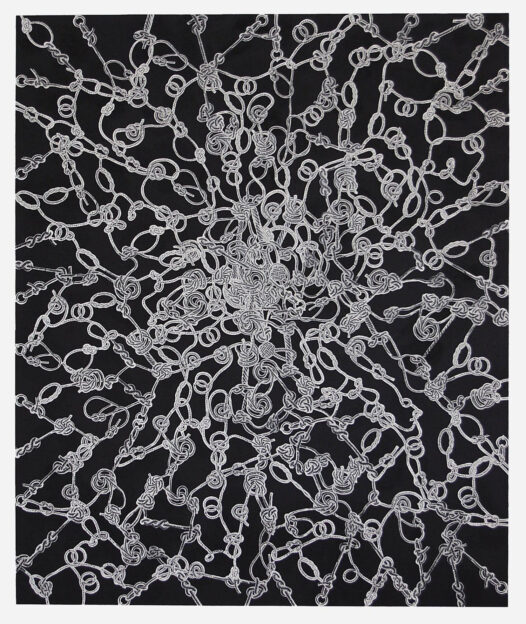
Tangle (2015)
Collage on board, 32 x 36 inches
Tangle is a collage woven from scores of small knot diagrams meticulously tied together on a black field. Given that the (instructional) images represent knots, the collage process of connecting them acquires a virtual quality or presence. Assembling this tangle of diagrams was akin to puzzle solving, although without a definitive or correct solution. It was simply a matter of trimming or modifying and then connecting the diagrams in ways that seemed congruent with the ways that actual knots might be tied together. Two things are apparent upon closer inspection of this work: the skein of knot images is denser in the center, and the entire ensemble appears anchored to the outer edges of the work’s frame, which is delineated by a narrow band of canvas. This connecting to the edges of the work (essentially its material support) creates a subtle illusion of suspension: a snarled trompe l’oeil net held in a frame. The work is formally abstract, and yet given the specific nature of the diagrams, the illusion of their suspension brings with it another sense of abstraction, one that is specific to the medium or technique of collage. The collage technique of cutting and tying pieces of knot diagrams together in a myriad of ways becomes self-referential given the work’s subject matter.
Finally, the work presents an interesting paradox: how can something be simultaneously ordered and disordered? Setting aside the problem of aspect perception (now ordered, now disordered), it may be this paradox that lends the work a palpable energy. A fundamental flux is brought to our attention.
………………………………………………
All images copyright and courtesy of Paul Forte
Get the Full Experience
Read the rest of this article, and view all articles in full from just £10 for 3 months.
No comments yet.