Talking to animals
Tom Mustill is a biologist turned filmmaker and writer.
His work with David Attenborough, Greta Thunberg, Stephen Fry and conservation and science heroes across the globe have won over 30 international awards, including two Webbys, a Wildscreen Panda, two Jackson Wild Awards and been nominated for a Primetime Emmy.
His book “How to Speak Whale: a Voyage into the Future of Animal Communication” is out now
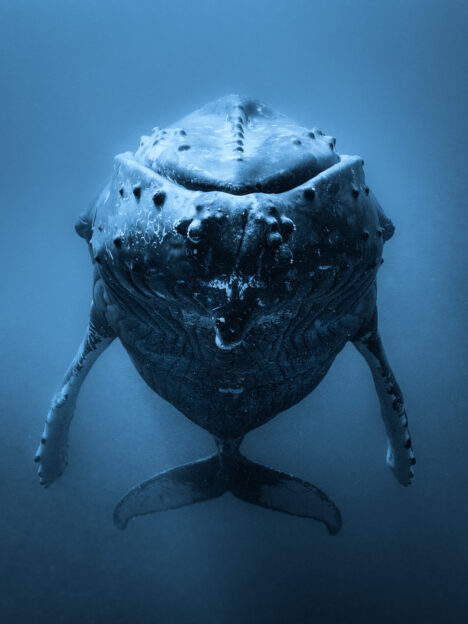
Humpback Whale (Photo credit: (c) J. Gregory Sherman)
Thirty-five years ago, a killer whale appeared off Washington state wearing a salmon for a hat. She carefully kept the dead fish balanced on top of her head. No one knew why.
Soon, members of other Southern Resident orca pods followed suit. For weeks, many of the giant predators sported salmon hats. Then, almost overnight, they all seemed to lose interest and stopped.
Currently, sailors of small boats have been warned to avoid large areas of the Spanish and Portuguese seas, as the killer whales there have been ramming into and biting their rudders. In two years there have been over 100 attacks. Two boats have been sunk. The animals show no sign of wanting to harm people. One sailor reported, “There were orcas everywhere. We were hit on the rudder 100 or 200 times. They were very focussed in their task.”
Scientists have speculated that the fish hats were a fashion craze, or teenage fad, that the rudder attacks are a game, or revenge. No one knows.
A bowhead whale can live for over 200 years. Their singing has been compared to jazz. In one bowhead lifetime the ages of sail, steam and diesel have passed. And three million whales have been killed, the greatest cull of any animal (by mass) in history. The blue whale, the largest animal ever to have lived, had its mightiest population reduced from 300,000 to 350. For humans this would be as if all the people in the world were killed, apart from those in Bulgaria. Sixty years ago, towards the end of the industrial whaling heydey, as factory ships searched Antarctic seas to fire exploding harpoons into the survivors so they might be rendered into dog food and fertiliser, Arthur C Clarke wrote: “We do not know the true nature of the entity we are destroying,”
And we still do not know.
My attention was drawn to how little we know about the nature of whales in a peculiar way, when a humpback whale the size of a double-decker bus leapt out of the sea and landed on my two-person kayak. It threw its 30-tonne body right out of the cold Pacific Ocean and smashed our vessel underwater, along with me and my friend Charlotte. Its sinking body pulled us deeper and I was thrown around like a doll. All I could see was white water. We somehow escaped unharmed. A humpback breach is estimated to release the energy equivalent to about 40 hand grenades. They do this often, all over the world. When I asked scientists why, there were many theories, but no answers.
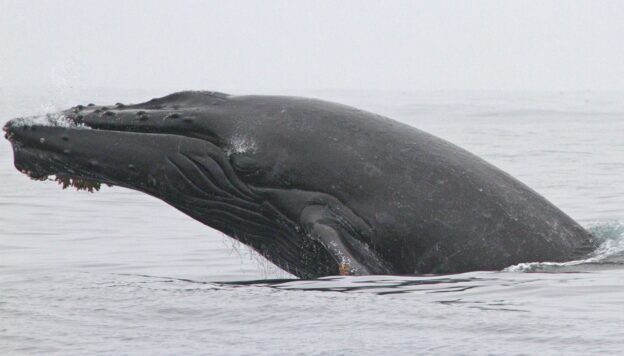
‘Prime Suspect’ the whale that jumped onto Tom and Charlotte (Photo credit (c) Happywhale)
When I swam with humpback whales to observe them singing, my whole body rang with their voices. I learnt to notice the structures of the songs, the repeating patterns within them. To see how the whales, after each twenty-minute performance, would return to the surface to breathe, before sinking back down to repeat the song. They sometimes do this for over 24 hours at a time. I watched another whale hovering close by, it was very still and seemed to be listening to the singer. The humpback whales employ rhythms and rhymes and constantly change their compositions. Some song elements go viral, particular whale ear-worms spreading from the sea (like the Australian humpback “hit factory”) where they are invented, and becoming incorporated rapidly into the songs of humpbacks across the world, as their singers’ migrations carry them to new waters. There’s even an argument that because humpback whales are so cosmopolitan, and sing everywhere, their song is the most widespread cultural product on earth.
There are many theories, but still no human knows what their songs are for.
I was trained as a biologist, and have worked for almost twenty years as a natural history filmmaker. I found it thrilling and surprising that these great compositions and energetic explosions remain unexplained. Of the subtler behaviours of the cetaceans (whales, dolphins and porpoises) we know even less. But this makes more sense when you think how hard it is to observe moving animals who spend most of their time submerged, sometimes hundreds of metres below the surface. Following whales’ lives beneath the surface is dangerous and tricky. Our human senses and bodies don’t work well there.
Despite these hurdles, the dogged scientists who study cetaceans have made thrilling discoveries, shaking off their human shackles with help from machines. I learnt this first hand. As the humpback landed on our kayak, the moment was filmed by a tourist. The video was analysed by experts who deduced that the whale turned away to avoid landing on us. Other researchers used a specially trained AI to identify the whale. They told us who he was, where he was born, who his mother was and mapped his migrations (we’ve followed him ever since). I was blown away by this and travelled to meet the pioneers adapting human tech to reveal the lives of cetaceans. They are designers of autonomous wave-powered boats that sail across whole oceans, listening for whales; teams who deploy cameras and other trackers onto the animals’ bodies, some who drop them on using drones; engineers building soft robot fish to swim among them and record their conversations; research institutes bugging the depths with huge arrays of underwater microphones (hydrophones). Over the course of the four years of researching my book, How To Speak Whale, scientists revealed to me what they had discovered: whale and dolphin lives of surprising richness.
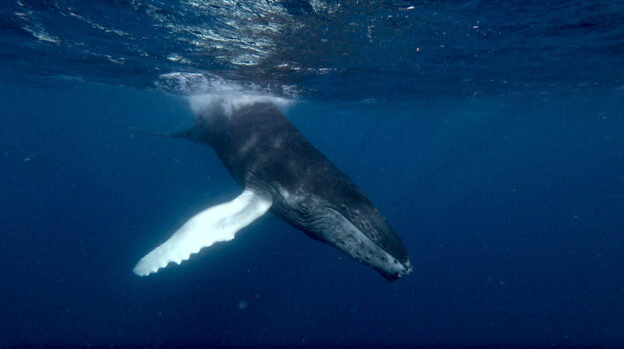
A humpback investigates the author in Dominica. (Photo credit (c) Tom Mustill)
Cetaceans have enormous complex brains (that of the Sperm whale is the biggest of any species), great hearing and virtuoso voices. Using these they knit together their long, often highly social lives with their sophisticated communications. Within their complex calls we have found that many species seem to have signature whistles (names) and ways of referring to their own social groups, and perhaps greetings. They make many other sounds, but we do not know their meaning yet. Blue whale voices can travel over 500 miles. Humpbacks charge in to protect other whales and even other species from attack by predators, lifting seals and porpoises and (by the account of one woman I interviewed), even humans out of the water on their bodies. I watched humpbacks guard the body of a dead grey whale calf for hours from the orcas that had killed it.
Cetaceans like to surf breakers, bow-ride on ships and make long-lasting friends across species boundaries. Some have been recorded “talking in their sleep”, and making what sound like impressions of other species. The woman who ran the tests told me that some dolphins leave gifts for human tourists, while others share tools among themselves. A few have been known to rape porpoises, and still more get high passing lightly poisonous pufferfish around. Some have been found to recognise themselves in mirrors – indications of consciousness.
Some cetaceans show signs of grief, carrying their dead calves around for days and weeks. Others care for their old and sick. The value of what a whale knows is so high that old females of many species undergo menopause, avoiding the risks of motherhood to guide their pods through danger. These cultures could well be much older than any of our own. They have likely been singing and chattering in the sea in their tribes far longer than we have been talking on land in ours. I find this all astonishing. Why search for extraterrestrial intelligence when fellow cultured animals swim in the seas alongside us all this time? It is an awful realisation when you think of what has already been lost: we have not just been killing species, or reducing “biodiversity”, but also wiping away individuals, personalities and cultures.
Ironically, our recent human cultures have been very resistant to the idea that any other earthbound species could have songs, cultures or names at all.
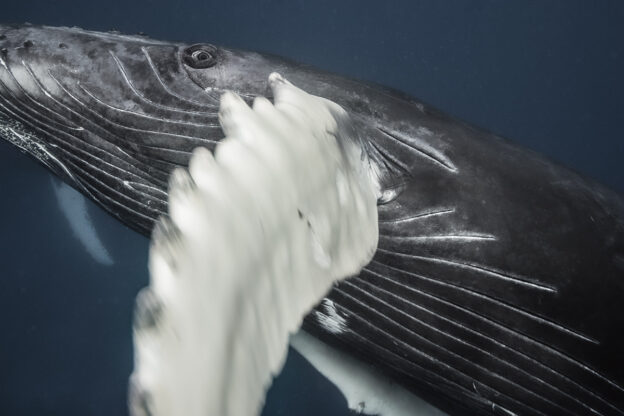
A humpback calf eyes photographer while passing very close. (Photo credit: (c) Jodi Frediani)
In the British legal system, and most other places, animals are considered “things”. There are laws to define how they are to be fed, housed and slaughtered, but they have no legal rights like humans do, like a right to life. In part this is a function of power, we can do these things, so we do. But it is also a legacy of our belief that we are profoundly different from other animals and special. That we sit at the top of a scala natura, or natural hierarchy. This allows us to grant ourselves moral licence to eat other animals and use them for our clothing and furniture coverings. But the old beliefs are waning in Britain. A recent UK census revealed 22 million of us have “no religion”. Without a divine stamp of approval, human exceptionalism rests on the evidence that we are unique and special. The more we look into the lives of other species, the shakier this evidence seems.
Parrots have been found to understand abstract concepts and coin new words, octopuses to solve puzzles and dream, fish to recognise human faces, vocalise and have distinct personalities. Other species cooperate and plan ahead; some memorise hundreds of words and do simple mathematics, some kiss with tongues and experience mental illness, others use syntax, fall in love, feel jealous and make friends. They feel pain, pleasure, perhaps love and awe and “spiritual” experiences, they gossip, kill for pleasure, exhibit morality, act altruistically, create art, dance to the beat, laugh when tickled. They feel pain when they see others in pain, they manipulate and deceive, rescue and comfort.
What were long-assumed absolute boundaries between humans and other species seem more now to be matters of degrees. In the words of the Yosemite ranger who tried to explain why it was hard to design a rubbish bin that bears couldn’t get into: “There is considerable overlap between the intelligence of the smartest bears and the dumbest tourists.”
The primatologist Frans de Waal uses the term “Anthropodenial” to describe our inclination to dismiss another animals’ behaviour when it seems able to do something a human can do. It is a powerful force. Perhaps the apex of our anthropodenial is in our reluctance to believe that other species might be able to communicate in ways like we do. For the philosopher Descartes, to speak and so display our unique human gift for rational thought is what ultimately sets us apart. But is it really just human beings who speak? I have been struck by how many philosophers and linguists have repeated the line that only humans have language, despite having only studied humans. How can they be so sure?
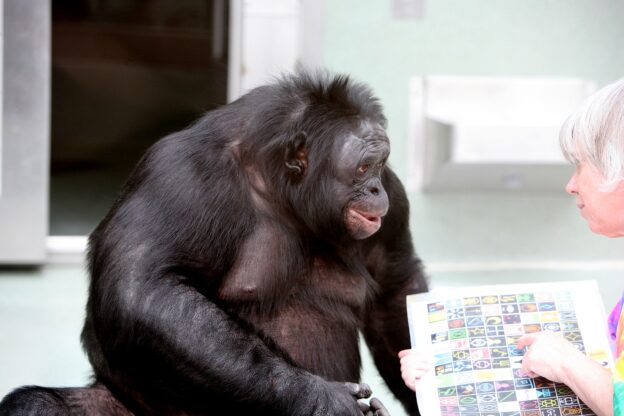
Kanzi the bonobo communicates using lexigrams with Dr Savaugh-Rumbaugh. (Photo credit (c) Liz Rubert-Pugh)
The evidence from studies on chimpanzees and other captive species has been mixed. But this is perhaps not surprising given that we have mainly been trying to teach laboratory animals, removed (often at birth) from their cultures and wild lives to master human languages or ersatz symbolic communication systems. We are also trapped in human brains with human ideas of language. This could make it hard for us to perceive it in species who wield it differently.
However, a big blow to our anthropocentrism may be about to arrive, courtesy of forces we do not fully understand. Many of the powerful AI tools developed to discover patterns in human behaviours are now being turned to investigate animal lives. One of the most promising fields is the analysis of language, where algorithms fed huge datasets can discern hidden patterns within human languages and learn to translate between them without the need for dictionaries (this is how Google Translate works).
Right now, massive research effort is underway in the waters off Dominica to use huge rigs of hydrophones, drones and robot fish to capture the biggest animal behaviour dataset of all time from the resident sperm whales, tailormade for AIs’ attempts to crack the codes of their communications. Project CETI aims to try and speak to the whales in 2026. This is just one expedition, and the tools it develops will be shared with those trying to crack the conversations of bats, crows, elephants and baboons. The datasets will keep getting bigger and the tools will become more sophisticated. What patterns we will discover in animal lives with these tools is uncertain, but many researchers I’ve interviewed believe they are already revolutionising biology. In biochemistry, for example, the AlphaFold AI in 2020 “solved” protein folding at a stroke: predicting the shape of every known protein, essentially completing an entire discipline of science.
If we decode the communications of other species, what would this mean for them?
Many of the researchers doing this science are motivated by the hope that gaining these windows into animal lives – becoming privy to their conversations and, perhaps, to speaking with them – could catalyse a healing in our broken relationship with nature. Imagine subtitles on wildlife films or in abattoirs. One described the power to me as “machines for making vegans”. In the history of law, the path to legal recognition for disempowered humans has often followed the recognition of their voices. Could this hold true for non-human rights if other species’ feelings were made explicit via machine translation?
And, if so, what would it mean for us? Would we face an identity crisis as the mainstay of our exceptionalism crashes; or would we seek a way to mitigate findings and cling on to our sense of pre-eminence? Would you still love your dog if he told you he preferred your neighbour? There are potentially dark outcomes too. To understand the communications of other species gives new powers to exploit them and each other. We already have a terrible record of first contacts among our own species. Before we “speak” to animals, we will be able to generate what sounds to other creatures like their communications, without actually knowing what messages we’re transmitting. We will be able to deepfake whale-speak. So there’s an ethical issue around not messing up animal cultures before we even know the true nature of what we are destroying. Before many of us believe such cultures even exist.
For my own part, I am optimistic about the impact of what these machine intelligences will help us to perceive. When hydrophones revealed to us that humpback whales sang, it galvanised the nascent environmental movement to cease their slaughter and helped save other species from extinction. Having closely observed recent breakthroughs in inter-species communication, I believe we have to take this fanciful-sounding idea very seriously: that whales might speak, and that very soon we will be able to speak whale (or at least an approximation of whale). And we need to decide how we do so. How to listen with the most scrupulous care and think before we, in turn, speak to them.
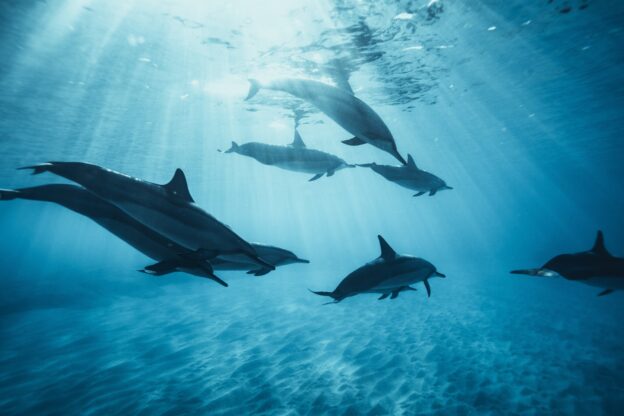
Shafts of light through dolphin pod.(Photo credit (c) Kammeran Gonzalezkeola)
……….
This article text was originally published in Perspective Media and is republished here with kind permission of Peter Phelps and Rowan Pelling.
…………………………………….
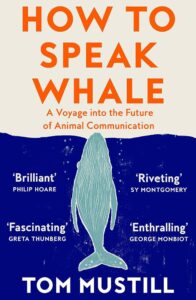
From the Afterword to How To Speak Whale: A Voyage into the Future of Animal Communication –
ME ROBOT, YOU WHALE
So what risks can we perceive in the domain of machine learning and cetaceans? Newly able to communicate with other animals in new ways, how do we prevent human actors from exploiting them for terrible ends? And of course, there is the law of unintended consequences: unthinking of how disruptive it is for others, we have accidentally polluted the seas with noise and plastic and filled the night skies with light. Could we similarly pollute animal cultures by talking to them? We have a terrible record of“first contacts” among our own species. Aza Raskin, from Earth Species Project, recently addressing the World Economic Forum claimed it would soon be possible to deepfake whale-speak. In fact, he believed this may already have happened. ESP research partners used humpback whale contact calls (thought to potentially mean something like “hello” and also perhaps encode the whale’s “name”) and trained a language model to create new ones to play to the whales. It should be noted that we have been doing this sort of thing with other species for decades with “playback” experiments. From monkeys to birds to elephants to dolphins, scientists have been playing them back both their own and modified sounds to see what they do, to try and understand what meaning they might have.
That we’ve been doing something for a while doesn’t mean we should continue. There is an argument that these experiments could help the whales, for instance if we could figure out a message to play that would warn them of oncoming vessels. There is a world where the whales are ambivalent to the synthetic voices they are played. But to me this is an unnerving power. The difference today with AI is that the sounds we play to animals will likely be more realistic. Aza described how just as he could now build a chatbot in Chinese, without speaking any Chinese language, that would convince a Chinese person, he thought, “We will likely … [from the whales’ perspective] be able to pass the whale Turing test”—and convince a whale that they are listening to another whale, or themselves, speaking. If you were swimming through the sea and a new, uncanny voice-name started saying hello to you from boats, would it terrify you, intrigue you, drive you mad? This is far from the world of speaking to animals imagined in Dr Doolittle. As Aza put it, “there is a sort of first contact moment that is about to happen but not in the way I think that we originally expected …”
The cultures in the sea have been around for a long time, possibly far longer than human cultures. They are already under great pressure. We sit at a crossroads. Just as we have discovered the existence of whale cultures and their fragility, we have a startling power. CRISPR is a gene-editing technology. One of ESP’s partner’s commented, “If we are not careful, we may have just invented a CRISPR of culture.” And rather than decoding whale-speak first and then deciding what to communicate, we can now communicate before we understand. Stepping back, perhaps playing semi-random AI-generated sounds at vulnerable animals with complex vocal cultures could be a bad idea? Should we stop all of this experimentation?
Since the book came out, I have realised how reductive most of our conversations about nature and technology have become, and how strongly I do not want to feed into this. I don’t think tech is inherently good or bad for nature. I think it is very powerful, and capable of harm and help. It cannot go unacknowledged that many of the cruellest situations we’ve imposed on other animals are facilitated by bespoke machinery. Pigs in intensive agriculture systems—often kept in concrete skyscrapers—can now be surveilled by AI systems twenty-four hours a day, making sure they grow optimally. SCOTT Automation has a lamb-processing system that X-rays and laser reconstructs each carcass before cutting and deboning an entire lamb at a rate of twelve carcasses a minute. One lamb through the machine every five seconds. Bats have been used by the US military as living incendiary devices, dolphins trained to kill divers and lay mines
Information is power, and information about animal communication systems can lead to great powers. Just as in the broader conversations on AI, these fast-developing tools can also promise help and hope. Roger Payne’s success is inseparable from the hydrophones, spectrograms and flexi-discs that made it possible. Discoveries we make with our ocean tools can motivate colossal change in the realms of conservation. The intentions behind technology matter, and unlike corporate-motivated CEOs, I believe scientists and conservationists are more likely and institutionally supported to pull back if they find their efforts are causing harm. The philosopher and technologist Jonathan Ledgard goes further. He believes it is vital that we steer AI to be invested in nature. “AI amplifies anthropocentrism.” He writes, “If it shows no curiosity for non-humans in this early stage of its evolution, it is less likely to be a steward of their interests or even to record their disappearance … Since wild animals, trees, birds, and other beings lack money and voice, there is every chance AI will be incurious of them at precisely the moment it should be paying attention.”
Of course, it would be a disaster to damage these cultures in the act of illuminating them, as the breath of awed explorers corroded ancient cave paintings and the oils of our fingertips can dissolve ancient manuscripts as we turn their pages. But to seal these animal cultures away from science looks unlikely to help save them, because their worlds are full of us already—only a tiny proportion of the disturbance in their lives comes from scientists.
So how do we navigate our way through what some are calling the Interspecies Age, as the revolution in tools gives us new opportunities for both harm and care? Do we walk away from this? Cetaceans already face existential threats and in some regards the genie is out of the bottle. One argument, and to me a powerful one, is that nature is taking such a hammering, we cannot only let the bad guys use the powerful new machines. In this view, eschewing certain AI tools to help serve conservation just because the tools were made by, for example, Facebook, could be like forswearing all boats because some pirates sail them. Software follows the orders it has been given, and there is a choice over how to wield these powers. Disengagement leaves the way clear for those without your scruples. Understanding what animals are saying, speaking to a whale, these sound perhaps silly, like children’s stories. But they are not silly. There are cultures in other species. We could learn from them and now soon perhaps communicate with them. They are fragile, unique, invaluable and not ours. The possibilities resulting from AI meeting nature are wildly different depending on how we choose to use these tools. I wrote this book so people would take this idea seriously, because I think it is deadly serious.
…………
The full text of the Afterword can be found here
……………………………………..

Tom Mustill (Photo credit (c) Sam Mansfield)
https://www.tommustill.com/how-to-speak-whale
Get the Full Experience
Read the rest of this article, and view all articles in full from just £10 for 3 months.

No comments yet.