Perception and Reality
David Rickard is a New Zealand artist based in London, UK. His original studies in architecture have had a lasting impact on his art practice, embedding queries of material and spatial perception deep into his work. Through research and experimentation his works attempt to understand how we arrived at our current perception of the physical world and how far our perception is from what we call reality.
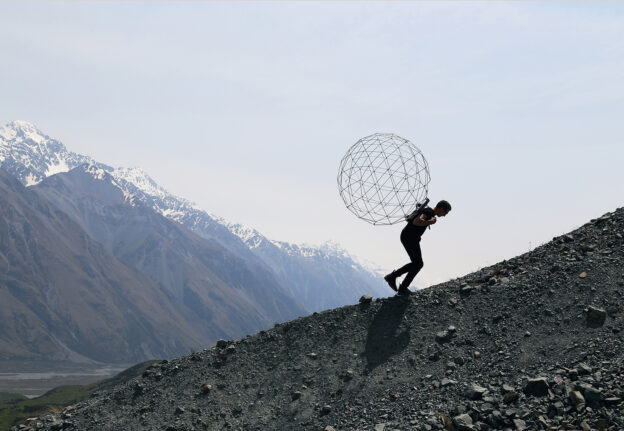
A walk in the alps (the middle of nowhere), 2019
Richard Bright: Can we begin by you saying something about your background?
David Rickard: I’m from New Zealand, where I grew up on a farm in the east coast of the South Island. I drew and painted endlessly when I was young, but also enjoyed science and maths. I guess it’s this combination that led me to study architecture at Auckland University. However, during my studies in architecture, I spent increasing amounts of time in the art school next door and eventually I went on to study art at Brera, Milan and then Central Saint Martins, London. Nevertheless, in many ways my original studies in architecture have had a lasting influence on my art practice, embedding queries of material and spatial perception deep into my work.
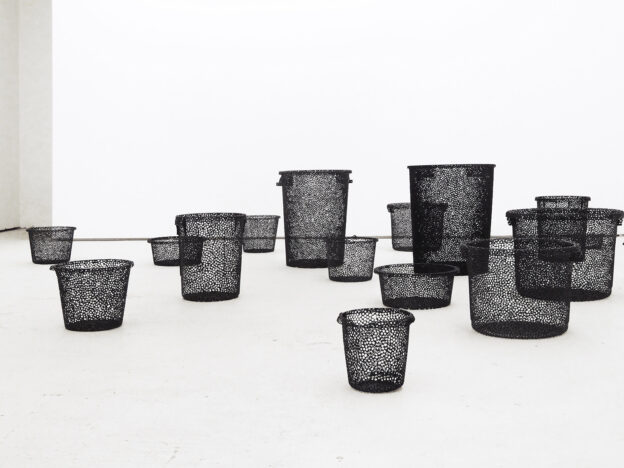
Dark Matter, 2013
RB: What is the underlying focus of your work? In particular, what are the thinking processes and knowledge practices that guide your artistic research?
DR: I work across a wide range of media including, sculpture, installation, performance and moving image. However, the works connect around a common thread of enquiry, which explores how we have developed our perception of the physical world and how far our perception is from what we call reality. During recent years this has led to collaborations with diverse universities and research labs, which is something I find incredibility interesting. The development of each work really begins from a conceptual question, which is concerned with understanding the underlying, and often imperceptible, nature of our physical environment. This leads to a combination of rigorous research and open experimentation as the work evolves, however throughout the process I’m constantly referring to the original query or concept to guide the process.
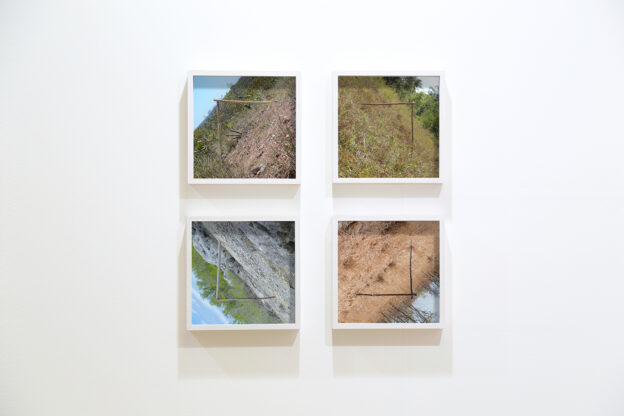
We are all Astronauts, 2015

Myriad, 2016 (realised in collaboration with CORD)
RB: Have there been any particular influences to your ideas and work?
DR: Yes, there are many. While studying architecture I became fascinated with artists which query the nature of context through conceptual experimentation. This type of work was really accelerated by the Italian movement of Arte Povera with its exploration of everyday materials and spaces, which is something I embraced while studying at Brera. There are also many contemporary artists that inspire me; however, I’m also fascinated with scientific research and the constant evolution of ideas and knowledge. Fortunately, this has led to several enriching collaborations with universities and hopefully it will lead to many more.
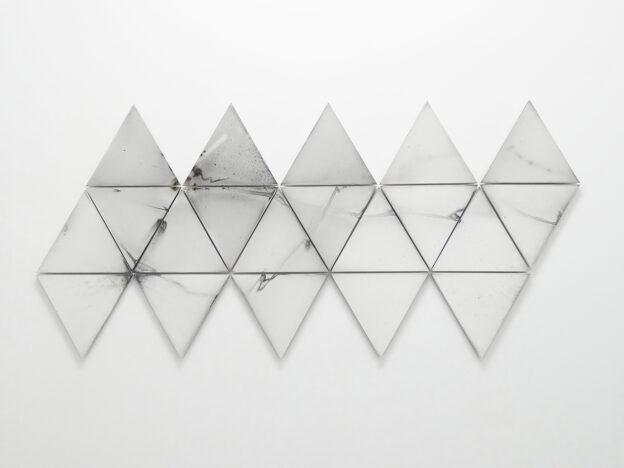
Star Gazer, 2014
RB: You have described your work Star Gazer (2014) as “formed by a chance event within an ideal form”. Can you say more about this work?
DR: The work Star Gazer was initially inspired by the research of Johannes Kepler, a 17th Century mathematician and astronomer, who believed he had discovered God’s geometrical plan for the universe (Mysterium Cosmographicum) by determining that the five platonic solids nested inside of each other relate proportionally to the orbits of the five know planets. The theory was relatively inaccurate and later crushed by the discovery of Uranus and Neptune.
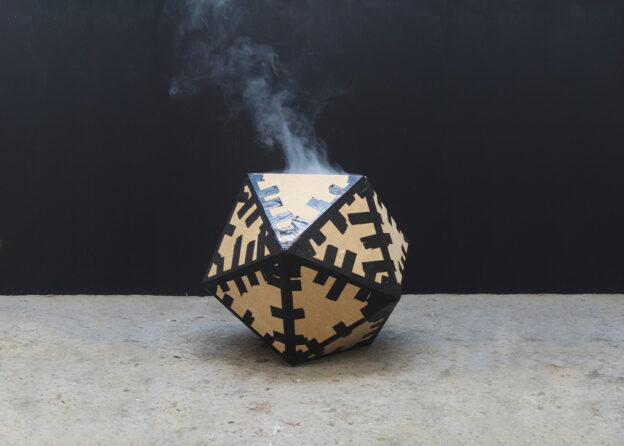
Star Gazer, 2014
Star Gazer starts with an icosahedron, the form which surrounds the earth within Kepler’s theory. Inside a physical model of this form a Star Gazer firework rocket was ignited and released to ricochet around the inner surfaces until detonation. Upon unfolding the sculpture, a sort of star map is revealed of an explosive event within the boundaries of an ideal system.
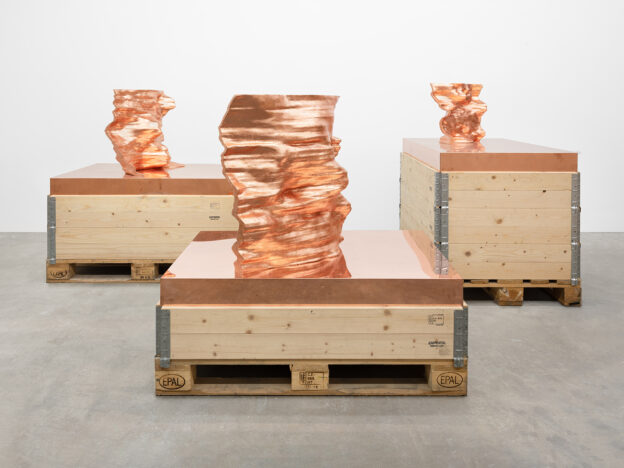
Beyond Sight Within Grasp, 2019 (photo credit: Eva Herzog)
RB: Your work Beyond Sight Within Grasp (Red, Yellow and Blue) was developed in collaboration with the Nano-electronic & Nanophotonic Materials Laboratory at UCL and Beyond Sight Loss, a community group supporting visually impaired people within East London. Can you say more about this work and its aims?
DR: This work was developed during the first edition of the Trellis residency at UCL during 2019, which paired artists with academics. I was drawn to the work of Prof. Tony Kenyon and the Nano-electronic & Nanophotonic Materials Laboratory and wanted to explore what it means to work at a scale smaller than the wavelength of light. In response to this threshold in vision several new types of microscopes were developed in the 1980’s which engaged other ways of ‘seeing’, including the Atomic Force Microscope, which measures movements in a very fine tip that gently hovers above, touches, or taps the sample surface. Considering this mode of observation led me to extend creative collaboration to members of Beyond Sight Loss, a community group for the visually impaired in East London.
The work considers copper at the scale relative to the wavelengths of red, yellow, and blue light (400nm, 550nm, 700nm) by magnifying a section of mirror polished copper surface at these scales by a factor of one million. The work evolved through processes of tactile scanning within an Atomic Force Microscope and the tactile aesthetic judgements of blind collaborators. The resulting sculptures attempt to invert the visual dominance typically found within public art, by engaging touch as a primary mode of sensory perception during the research, development, and reception of the artwork.
RB: Your works Exhaust (2011), A Roomful of Air (2019), International Airspace (2019-20) and Sometimes doing nothing leads to something (2020) explores the nature of air and our connection with it in different ways. Can you say more about his?
DR: Air is the invisible substance that sustains and connects us all. It embodies the intimate connection between personal and planetary health, while holding a fingerprint of our environment’s history within its chemical composition, from the distant past of our planet to modern day pollution. For these reasons it is a substance that has formed the focus of several works.

Exhaust, 2011 (photo credit: Manuel Vason)
Initially, I was interested in revealing our personal demands on the air that surrounds us, which resulted in the 24-hour continuous performance Exhaust during which all my exhaled air is collected into an ever-increasing mass of foil balloons. This later evolved into a single meteorological balloon which dwarfed the exhibition space with Sometimes doing nothing leads to something.
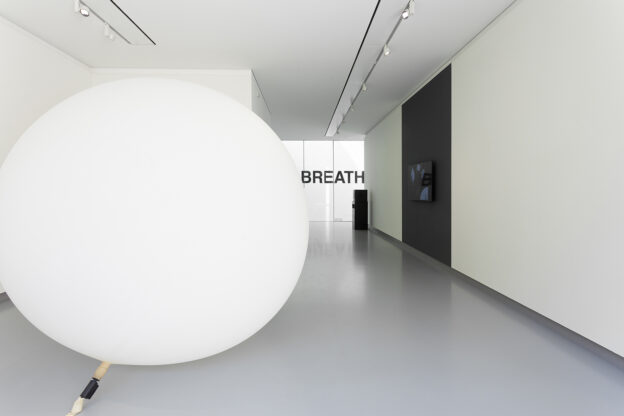
Sometimes doing nothing leads to something, 2020 (photo credit: Museum Kranenburgh, Michel Claus)

A roomful of air, 2019
The work A Roomful of Air also considers the physical presence of air. After carefully measuring the volume of a room, alongside the altitude, humidity, and temperature, the weight of the air contained within can be determined. This weight is then made physical as stack of lead or concrete blocks on the floor. It’s a work that surprises people as we always consider air to be nothing, yet its accumulated weight is vast and the only reason we aren’t crushed by the weight of the atmosphere above us it that we are equalised by the air within us.
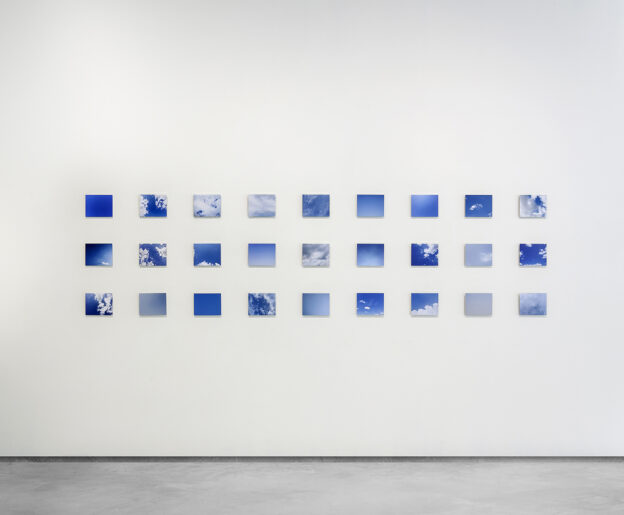
International Airspace, 2020. (photo credit: Museum Kranenburgh, Michel Claus)

International Airspace, 2020
However, beyond the physical aspect of air, it is also a highly political substance. This was explored with the work International Airspace which grew from research into the nationalisation of airspaces with the ‘Paris Agreement’ in 1919, which was signed by 27 countries. To make the work I collaborated with locals within each of the signing countries by posting them supplies and instructions so that they could send me samples of their airspaces. Naturally this was a futile exercise as the air continually crosses borders as it circulates around the globe approximately every two weeks. However, despite the logistical issues of posting air samples around the world, they were all collected and combined into a single Pyrex glass vessel, with the help of Leicester University School of Chemistry, so a new invisible international airspace was formed based on trust and collaboration.

Flotsam, 2022
RB: Can you say something about your work Flotsam?
DR: This recent work, originated from an interest in the various theories proposed to reconcile the world of quantum physics with physical reality, in particular Hugh Everett’s ‘Many Worlds Interpretation’ first proposed during the 1950’s.
The title Flotsam refers to physical debris adrift on ocean waves whilst also acknowledging the underlying premise of the wavefunction within quantum physics. The work began as a series of world map globes which are removed from their stands and with the help of internal electronics roll around the gallery space.
By selecting used globes originating from different countries and eras, a range of different borders and territories are mapped across their surfaces. The resulting installation is formed of many globes of differing world views migrating around the floor and bumping into each other, the gallery walls, and people within the space. Eventually, over the course of the exhibition the globes leave a subtle tideline of small impacts around the gallery walls as memory of their movement.
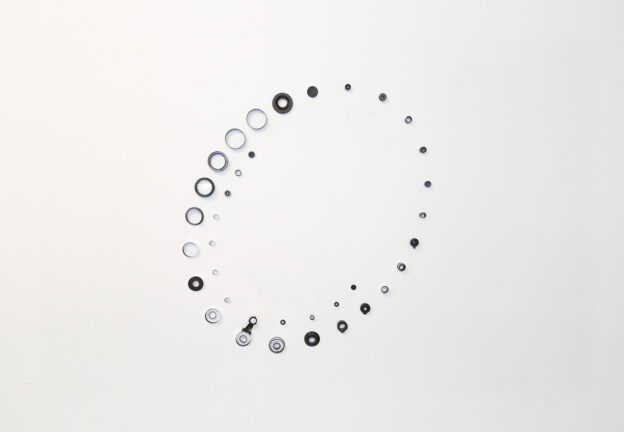
Eclipse (Annular), 2022
RB: Pushing the boundaries of the medium is a natural part of the art making process because, in some ways, the artist is exploring the medium itself. What boundaries do you wish to push with the medium that you use?
DR: I’m interested in pushing the boundaries of our understanding and perception of the space we inhabit.
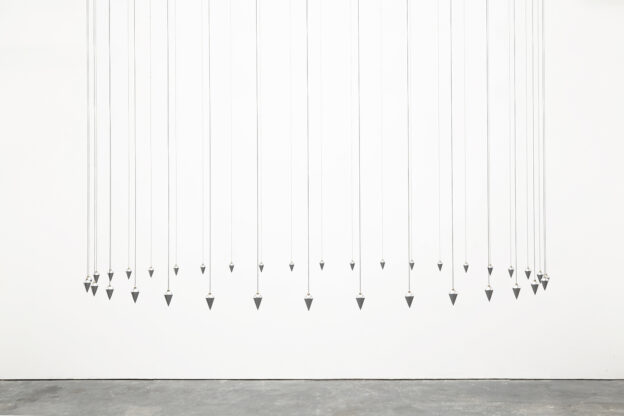
36 lines describing a truncated cone, 2016
RB: What future projects are you currently working on?
DR: There are currently a range of different projects in the studio, including a large collaborative work exploring the new possibilities with post and borders supported by Horizon2020. I’m also working on a new series of paintings made from rainwater and ink that combine AI generated cloudscapes with AI generated statements of consciousness. I think of these as physical clouds engaged in depicting their digital alter egos. The first of these works are included within my current solo exhibition ‘Throwing Dice in the Dark’ at Michela Rizzo GMR2 in Mestre, Italy.
I’m also beginning work on a public commission for central London related to air quality which will be announced soon. Lastly, I’d recommend anyone interested in the dialogue between art and science to see ‘SEISMIC / Art meets Science’ on at GIANT Bournemouth until 20th Jan 2024, where my recent work Cosmic Field (3.7mHz) is an array of hi-hat cymbals played by passing cosmic rays.
…………………………………….
All images courtesy of the artist, CØPPERFIELD London and Galleria Michela Rizzo, Venice
Get the Full Experience
Read the rest of this article, and view all articles in full from just £10 for 3 months.
No comments yet.