Communicating
Issue 86 November 2024


Talking to animals
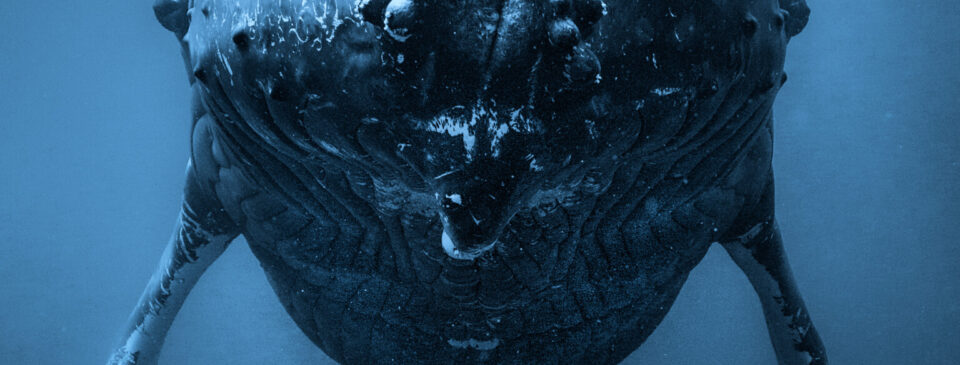
Tom Mustill is a biologist turned filmmaker and writer.
His work with David Attenborough, Greta Thunberg, Stephen Fry and conservation and science heroes across the globe have won over 30 international awards, including two Webbys, a Wildscreen Panda, two Jackson Wild Awards and been nominated for a Primetime Emmy.
His book “How to Speak Whale: a Voyage into the Future of Animal Communication” is out now

Intuition’s Truth
Taney Roniger is a visual artist, writer, and educator based in New York. Since the late 90s she has been exploring the relationship between art, science, and the spirituality of immanence in both her work as an artist and in numerous essays and symposia.

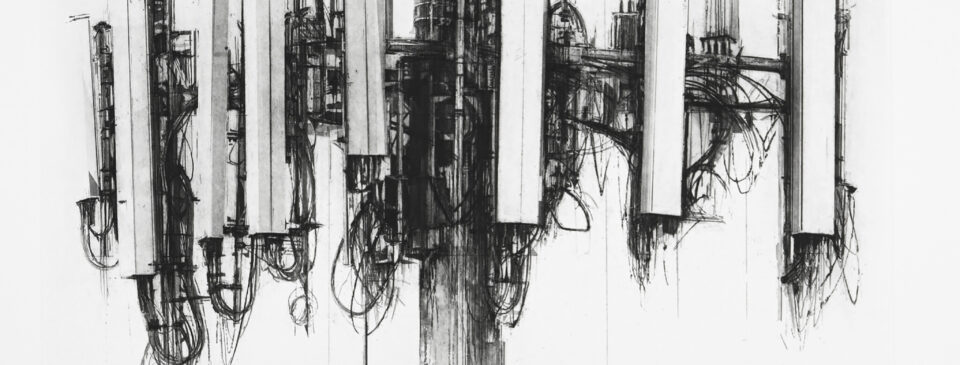
Structures of Communication
Through drawing and printmaking Ian Chamberlain reinterprets man-made structures as monuments in the landscape. These structures are architectural metaphors of past and current technological achievements. He has had a long-standing fascination with technology and architectural forms especially the structures within industry, agriculture, science and the military. These have included Goonhilly Earth station, The Lovell Telescope, Cheshire Maunsell Sea Forts in the Thames estuary and the Acoustic Sound Mirrors on the South Kent Coast.

This Land, Marginalia, and Chronicles of Fallacy.
Stephen Nowlin is Los Angeles-based artist, curator, and writer whose practice is inspired by science, the histories of science and art, and theories of knowledge. His work employs the use of digital tools, photography, and scanning technology, resulting in small and large-scale limited edition archival pigment prints. In this article he discusses his work of the last few years which has developed along three ongoing series: ‘This Land’, ‘Marginalia’, and ‘Chronicles of Fallacy’.
The Encounters Trilogy
Garry Kennard is a painter, writer and founding director of Art and Mind (www.artandmind.org). A fascination with how the brain reacts to works of art has lead Kennard to research, write and lecture on these topics. With Rita Carter and Annabel Huxley he devised and directed the unique Art and Mind Festivals which attracted leading artists and scientists to explore what light the brain sciences can throw on contemporary culture.

Do mushrooms really use language to talk to each other? A fungi expert investigates
Katie Field is Professor in Plant-Soil Processes, University of Sheffield.
“I have two key research interests. The first is plant-fungal symbioses and their applications in sustainable agriculture. Today, it is estimated that more than 80% of land plants, representing over 90% of plant families, form nutritional symbioses with soil-dwelling fungi. My research aims to expand our understanding of these symbioses with important applications in sustainable agriculture.
I’m also interested in the evolution of plant-fungal symbioses, and in particular how the biotic and abiotic environments interact to drive plant evolution and the development of the terrestrial biosphere. This key question underpins my research into the interactions between ancient land plant lineages and symbiotic soil fungi. Plant-fungal symbioses date back to when plants first colonized Earth’s landmasses more than 475 million years ago, and we are only just starting to understand the diversity, structure and physiological function of the relationships between early branching lineages of land plants and their symbiotic fungi. My research aims to shed new light on the role fungal symbionts may have played in the development of Earth’s ecosystems”.

From glowing corals to vomiting shrimp, animals have used bioluminescence to communicate for millions of years – here’s what scientists still don’t know about it
Danielle DeLeo is a Postdoctoral Researcher at Florida International University and a Research Associate at the Smithsonian’s National Museum of Natural History, using genomic techniques to study the evolution of bioluminescence and vision in the deep sea. “My additional projects harness the power of genomics to better understand how marine invertebrates respond and adapt to both natural and anthropogenic environmental conditions.”
Andrea Quattrini is a Research Zoologist and Curator of Anthozoa in the Department of Invertebrate Zoology. She studies the ecology and evolution of corals and associated communities, and often focuses her questions on those that live in the most poorly studied environment on earth—the deep sea. Andrea strives to work on projects that directly connect with resource managers in order to help effectively conserve vulnerable marine ecosystems in the face of global ocean change

In a future with more ‘mind reading,’ thanks to neurotech, we may need to rethink freedom of thought
Parker Crutchfield is Professor of Medical Ethics, Humanities, and Law, Western Michigan University. He completed his Ph.D. in philosophy at Arizona State University, working in applied ethics, epistemology and the philosophy of science. As Professor in the Department of Medical Ethics, Humanities and law at WMed, Dr. Crutchfield conducts research in medical ethics.

The silent conversations of plants
Sven Batke is Associate Head of Research and Knowledge Exchange – Reader in Plant Science, Edge Hill University. He completed his PhD at Trinity College Dublin in Plant Biology. He currently holds the position of Associate Head of Research and Knowledge in Biology and is a Reader in Plant Sciences. His research interests are in crop science, tropical ecology and taxonomy.

Seti: how we’re searching for alien life at previously unexplored frequencies
Owen Johnson
“I am an Irish astrophysicist, currently enrolled as a PhD researcher at Trinity College Dublin , jointly supported by UC Berkeley under the supervision of Prof. Evan Keane and Dr. Vishal Gajjar . My research is based on transient astronomical objects using everything from pulsars as gravitational probes to searching large data sets for signs of ET.
I completed my undergraduate degree in Physics with Astronomy and Space Science at University College Dublin (UCD) in 2022. During this time I worked as a research assistant at UC Berkeley. Working primarily using LOw Frequency ARrays (LOFAR) searching for technosignatures, pulsars and FRBs.”

Vital Signs: another world is possible
‘Vital Signs: another world is possible’ is Science Gallery London’s new, free exhibition and events programme. It brings together artists, designers and researchers to explore how the health of the natural world is intimately connected to our own health and wellbeing from the waterways and atmosphere to the ocean floor. Revealing unique perspectives on our surrounding environments through multimedia installations, research collaborations and A Living Library, Vital Signs reinforces that humans are fundamentally a part of nature rather than apart from it.