Being Human (with AI 2)
Issue 78 July 2023

Human-Machine Collaborations
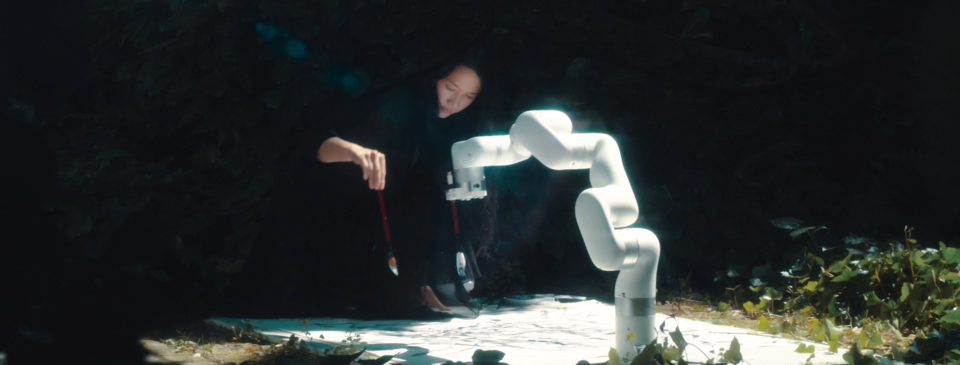
Sougwen 愫君 Chung is a Chinese-Canadian artist and researcher, and is the founder and artistic director of Scilicet, a London-based studio exploring human & non-human collaboration. A former research fellow at MIT’s Media Lab, she is considered a pioneer in the field of human-machine collaboration – exploring the mark-made-by-hand and the mark-made-by-machine as an approach to understanding the dynamics of humans and systems.

Boris Eldagsen: The Woman Who Never Was
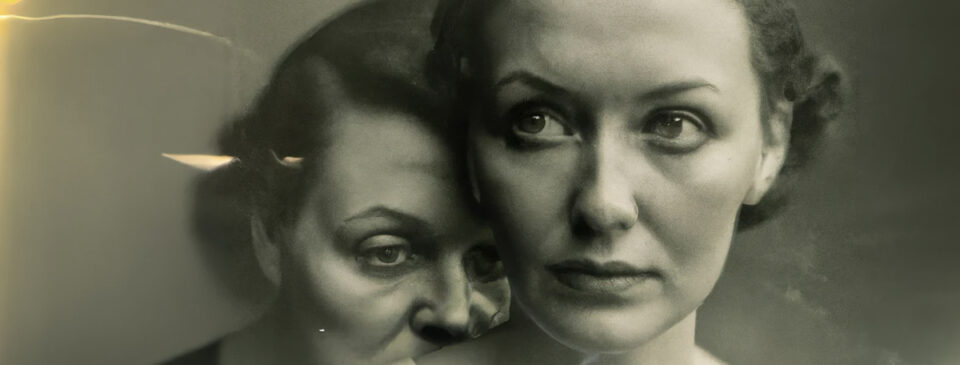
The winners of the 2023 Sony World Photography Awards (SWPA) – reputedly the world’s largest photography competition – were announced in March. The image that won the Creative section was by the German artist Boris Eldagsen. Entitled ‘The Electrician’, it is a haunting image of two women: the older hiding behind the younger. A man’s hand appears mysteriously from out of frame. The vibe is 1940s retro and, while the image has its own enigmatic beauty, there is something uncanny about it.
Perhaps what underlies this sense of the uncanny are two facts: the young women and her shy companion never existed… and this is not a photograph. The image is from a series called ‘Pseudomnesia’ created by the artist using an Artificial Intelligence (AI) image-generation system called DALL E2.
BUT, IT’S BEAUTIFUL! Why Artificial Intelligence Can’t Make Art
Steve Sangapore is a contemporary oil painter and mixed media sculptor. Using vastly different stylistic approaches of composition, medium and structure throughout various series, his work can be described at once as aesthetically traditional and conceptually contemporary. His work is intellectually exploratory with a gravitation toward religion, science and the human condition.

The Edge of Me
‘The Edge of Me’ offers a personal perspective of what it is like to live inside a mind that is both brimming with creativity yet sometimes at the mercy of overstimulated and self-destructive thought patterns. The piece explores some of the possible neurological bases of these experiences, looking at the brain as a predicting machine and the role of the Default Mode Network in creative thinking, negative rumination and possible links to ADHD.
Poems
Mykyta Ryzhykh is a poet from Ukraine. Winner of the international competition ‘Art Against Drugs’, bronze medalist of the festival Chestnut House, laureate of the literary competition named after Tyutyunnik. Nominated for Pushcart Prize. The poet’s poems have been published in magazines and on the portals Soloneba, Littsentr, in the Ukrainian Literary Gazette, Bukovynsky Journal, in Stone Poetry Journal (USA), Tipton Poetry Journal (USA), divot poetry journal (USA), Alternate Route (07/2022, USA), dyst journal (USA), Better Than Starbucks Poetry & Fiction Journal (USA), Allegro Poetry Magazine (USA), Littoral Press (UK).
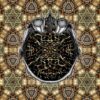
Inner Selfies
The ‘Inner Selfies’ Project is a public-engagement initiative created by artists Hanif Janmohamed and Maria Lantin, in collaboration with the Art Gallery of Ontario. It is a hybrid work with a physical maker space at the AGO’s Community Gallery and a public online digital space, with the Inner-Selfie Drawing Tool. The exhibition opened in July 2022 as an emergent work that engages with concepts of self and no-self. They are interested in questioning selfie culture and in the co-creation of new, poetic representations of identity and self. The exhibition runs until August 31 2023.
Three minds: physicist, poet, philosopher
The minds are those of international physicist David Bohm, German poet Hans Magnus Enzensberger and Canadian Blackfoot/Indigenous philosopher/ researcher Leroy Little Bear.
Bohm saw thought as a system, a network of connections passing seamlessly between people throughout society. Enzensberger said that a poem, notably his summer poem, is a netlike construction which can catch new experience again and again. Little Bear said the Blackfoot mind is a repository of creativity through the notion of constant flux: a ‘spider web’ network of relationships where everything is interrelated.
The overlap between these views can illumine consciousness and thinking.
AI will soon become impossible for humans to comprehend – the story of neural networks tells us why
David Beer is Professor of Sociology at the University of York, UK. His most recent book is ‘The Tensions of Algorithmic Thinking: Automation, Intelligence and the Politics of Knowing’ (published by Bristol University Press).
David’s research explores how transformations in technology and media have reshaped culture and society. In recent years his work has focused mainly upon questions around the politics of data, metrics and algorithms. In addition to this, he also works on the history and future of social thought.
He serves on the editorial boards of the journals Theory, Culture & Society; Information, Communication & Society; Cultural Sociology; and Big Data & Society.

Can machines be self-aware? New research explains how this could happen
Michael Timothy Bennett is a PhD Student, School of Computing, Australian National University
“After obtaining a masters from London Business School, I worked for 7 years in the technology sector in the UK, Italy, US and India. After founding a successful machine learning consultancy in London, I returned home to Australia to undertake research focused on artificial intelligence, studying at the ANU.”
How uploading our minds to a computer might become possible
Angela Thornton is a PhD Candidate, University of Nottingham
“For my PhD thesis I have been exploring public awareness and attitudes to mind uploading. Up until 2018 I was an industry market researcher specialising in healthcare although I also have business to business and consumer experience. I have over 30 years’ experience and have held senior roles at several agencies including Ipsos MORI and Research International (South Africa) where I was the Qualitative Director on the Unilever account. In 2014 I set up my own consultancy ACT Research Ltd and this gave me the opportunity to fulfil a long-held ambition to gain a post graduate qualification as a mature student. I achieved a Distinction in my MSc from the University of Nottingham and was subsequently accepted onto the Horizon Centre’s Doctoral Training Programme which focuses on the digital economy and digital innovation.

Futurists predict a point where humans and machines become one. But will we see it coming?
John Kendall Hawkins is a Philosopher at the University of New England.
“I am an American ex-pat poet and freelance journalist and lifelong student currently residing in Oceania. I’m a philosopher — panpsychism, so residing, when you think about it, everywhere.”
He is a former reporter for The New Bedford Standard-Times, and a former columnist for the Prague Post. His poetry has won multiple awards, including the Academy of Ameican Poets prize in 1984 and the Deakin Literary Award in 1998.
Sandy Boucher is a Lecturer in the Philosophy of Science at the University of New England, NSW Australia.
“My research interests are mainly in the philosophy of biology (especially functions and teleology, the units of selection, species, natural kinds, macroevolution and paleobiology) and general philosophy of science (especially the scientific realism debate), but I also work on issues in metaphilosophy and epistemology. Current research projects include work on pragmatism in the scientific realism debate; arguments for realism about the units of selection; the role of values in science; and naturalised metaphysics.”

Cyborgs v ‘holdout humans’: what the world might be like if our species survives for a million years
Anders Sandberg is a James Martin Research Fellow, at the Future of Humanity Institute & Oxford Martin School, University of Oxford. His research centres on societal and ethical issues surrounding human enhancement and new technology, as well as estimating the capabilities and underlying science of future technologies. Topics of particular interest include enhancement of cognition, cognitive biases, technology-enabled collective intelligence, neuroethics and public policy. He has worked on this within the EU project ENHANCE, where he also was responsible for public outreach and online presence. Besides scientific publications in neuroscience, ethics, and future studies, he has also participated in the public debate about human enhancement internationally. Anders also held an AXA Research Fellowship and is now the senior researcher in the FHI-Amlin collaboration on systemic risk of risk modelling.

The Art of Being Posthuman: Who Are We in the 21st Century?
Francesca Ferrando’s forthcoming book, ‘THE ART OF BEING POSTHUMAN’, offers a comprehensive reflection on the existential condition of the 21st century. A visionary introduction to existential posthumanism, it takes the form of eight meditations of posthuman self-inquiry.

Lines of Empathy
‘Lines of Empathy’ is a group show brought together by Italian, London-based, artist Giulia Ricci. The title ‘Lines of Empathy’ is a synthesis of the project’s main themes: on one hand the exploration of the process of mark-making while drawing on paper by hand, on the other, empathy as the act of reaching out into someone else’s experience.