Intuition’s Truth
Taney Roniger is a visual artist, writer, and educator based in New York. Since the late 90s she has been exploring the relationship between art, science, and the spirituality of immanence in both her work as an artist and in numerous essays and symposia.
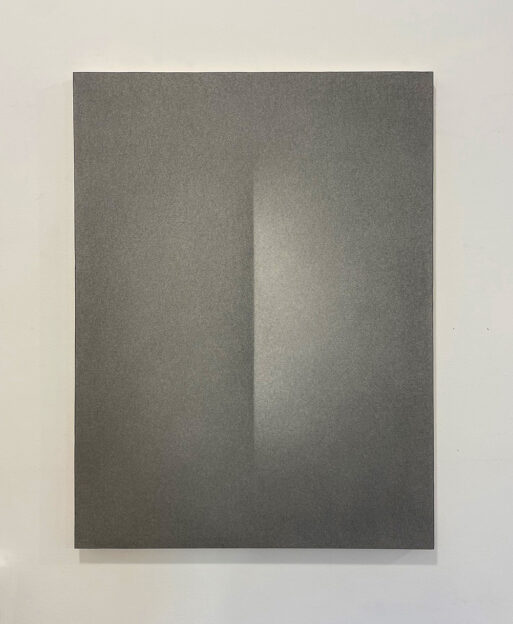
Taney Roniger, Slit, 2024. Graphite and charcoal on paper mounted on panel, 24″ x 18.” Photo: Concatenations.org.
We begin in Vienna, sometime in the early 1930s. In a small room set off from the clamor of the city, a man lies face up on a couch. The shades are drawn. Perhaps, to enhance the darkness, he’s placed a mask over his eyes. His senses secured against external stimuli, another, interior sense rustles into consciousness. Slowly the man’s mind empties of noise. Finally, the line is open, the channel clear: the man is ready to begin receiving.
And, almost certainly, receive he will. The man is the Austrian mathematician Kurt Gödel, and the insights thus revealed to him would alter the course of his field. While the nature of those insights has some bearing on our subject, it is the means by which they arrived that concerns us here. For Gödel was a believer in mathematical intuition, a way of accessing mathematical truths not deducible by reason. A practicing Platonist, he held that intuition’s truths were the ultimate reality – the metaphysical givens from which all else was derived – and that they could only be divined through direct mental transmission. By his own account, it was only in these sessions of willed disembodiment that he was able to intuit these truths.
For artists, Gödel makes for a compelling provocation. To begin with, he gives the lie to one of our most entrenched cultural assumptions: that mathematics and science traffic exclusively in reason, while the arts, being irrational, are all intuition (and, as a particularly unfortunate corollary, that reason is male and intuition female). But even more relevant is the peculiarity of what intuition meant to him. When artists think of intuition, what we usually have in mind is something that comes from within; it is a subjective phenomenon sourced in the depths of the self. For Gödel, intuition’s source lay outside the self entirely, in an immaterial realm over and above the one we inhabit where pure truths lie waiting to be disclosed. The difference is striking. But, with all due respect to Gödel, whose discoveries themselves remain unassailable, what if both are wrong? What if the contents of intuition come from neither in here nor up there but arise from some third, more complex place? If so, how are its gifts conveyed to us? In a time of mounting skepticism toward binaries of all kinds, these questions seem ripe for consideration. But they are especially pertinent questions for artists right now, and for two far-from-trivial, nested reasons.
The more immediate reason intuition should concern us today has to do with the shift we’ve been seeing in our field over the last few decades – namely, the move away from art as a form of poetry and toward the artistic enterprise as an analytical activity. As art has become ever more discursive, granting primacy to explicit content over tacit, embedded meaning, intuition has joined beauty in the ranks of the unmentionables. Saying one’s work is intuitive will get precisely no one into graduate school these days; “serious” work must be founded in articulable ideas – ideas that, in many programs now, must be defended in a written thesis if one is to graduate. While there is an argument to be made for greater literacy among artists, the devaluation of intuition as a valid means of working is tantamount to dismissing the tacit itself, the communication of which, it must be said, is why art exists in the first place. But the matter is more urgent still. For the larger reason intuition begs reconsideration right now is that it’s not just art that’s becoming more discursive; indeed, it is our culture as a whole. Enthralled to reason as the only legitimate means of discerning truth, we have come to see intuition as unscientific, even woolly – the kind of thing that leads to poor judgements and muddled thinking, or the kind of thing, more pointedly, fit only for women and children. Given this pervasive cultural bias, our capacity to engage with our intuitive faculties is in danger of atrophying, perhaps even of being extinguished altogether. Before we let this happen, it seems we owe it to ourselves to at least ask what it is that we’re forsaking – what we as artists are forsaking. Might a new understanding of intuition help us rethink art’s trajectory? As it happens, with the current surge of interest in the body’s role in our intelligence, there is ample reason to believe we’ve been getting it all wrong.
*
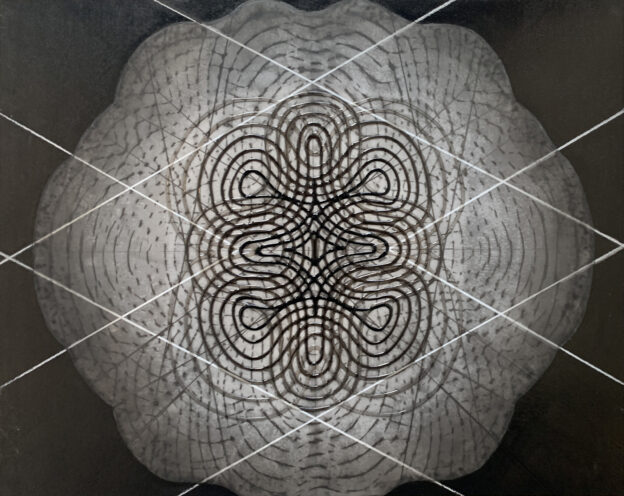
Daniel Hill, Equivalent 14, 2024. Charcoal, graphite, chalk, and acrylic polymer emulsion on paper mounted on panel. 16″ x 20.” Photo: Daniel Hill.
Few people have done more to argue for intuition’s validity than the psychiatrist and polymath Iain McGilchrist. In his new book, The Matter with Things, he dedicates four chapters to the subject, citing study after study showing the authority of intuitive insights.[1] Based on the evidence he has amassed, it is clear that intuition is by no means purely subjective, but neither does it come from some transcendent, objective plane. Above all, it is not arbitrary, and, as he is at pains to make clear, we disavow it at our own peril. For as many of the experiments he cites show, intuitive judgments are often not only correct but are reached far more quickly than the products of conscious thought – an advantage clearly vital in situations of danger. What’s more, in many instances conscious reasoning impedes good judgement by interfering with processes that must remain tacit. What are we to make of this? If not channeling from some immaterial realm, is our intuition, like Gödel’s, doing something supernatural?
In fact, the answer appears to be no; we needn’t reach into the paranormal to explain the phenomenon (which is not to dismiss the supernatural, be it noted, since it may well be that today’s “natural” might someday subsume what we now consider “super” to it). Among the many case studies that McGilchrist cites, one is particularly revelatory. In it, he tells of a racehorse trainer who had a special gift, which was that he could predict, almost without fail, which horse would win a race. This he did not by reading numbers or by performing any kind of statistical analysis, but merely by looking at the horses and listening to his intuition. All he needed was a few minutes, and time and again his predictions proved right. Despite his success, however, it bothered the man that he couldn’t explain these feats of foresight (one can imagine the looks when he told his friends it was “just a feeling”), so at some point he set out to study himself. After a period of remarkable self-observation, he arrived at a conclusion as stunning as it is simple. It turns out that the man’s ability was largely the result of body reading – that of his own body reading those of horses and jockeys. The horses’ state of health, whether they were calm or anxious, whether horses and riders seemed mutually attuned: informed by the subtlest of perceptual cues, the man’s unconscious was making assessments that concluded in a “gut feeling,” the cues turning out each time to have been decisive for the race. Neither weird nor woolly and certainly not supernatural, this man’s feats were ones of sensory perception coupled with, or followed by, intelligent discernment – both unconscious, and both astonishingly rapid.[2]
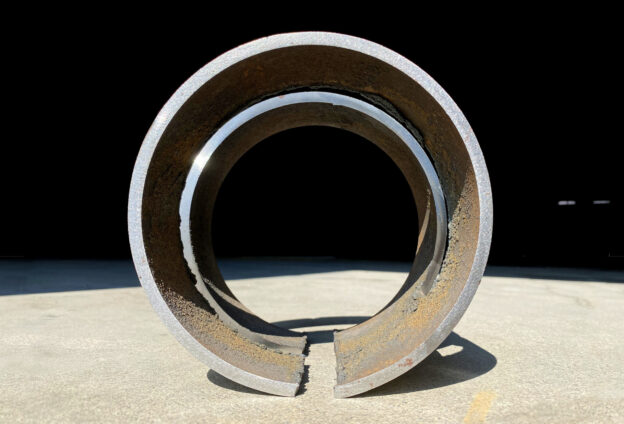
Christine Corday. HELDAN, 2010. Weathering Steel. Variable Dimensions. Photo: Corday Studio.
Of course, the idea that we perceive far more than we are conscious of is not new. As advertisers have known all too long, our brains register images present to us for mere microseconds – images of which we have no conscious awareness but that can lead us, say, to suddenly feel hungry. But the question to consider here is how this relates to intuition. Could it be that those gut feelings we cannot explain are our bodies’ way of telling us we’ve perceived things of consequence? That analyses have been performed by our unconscious thought, which, it’s worth remembering, makes up 98% of our cognition? In light of the evidence, this seems more than plausible. And if it is so, the locus of intuition becomes plural rather than singular: internal in the sense that it registers in and is assessed by the body, it is external in that its raw material originates in the sensory world. Essentially the product of an interaction or exchange – that between a human organism and the material matrix of its environment — intuition should rather be called “intertuition.”
Matter in tacit conversation with other matter: The implications for art are most alluring. But before we get there, several caveats are in order. First, no one here is claiming that intuitions are always right. Certainly they are not, but this does not negate the fact that they very often are. And then there is clearly a range in humans’ intuitive capacities. Just as some people are more athletically gifted than others, there are those whose senses are more sharply attuned, as well as those who, though sensorially sharp, are too alienated from their bodies to recognize gut feelings. But what is certain is that intuition is a part of human intelligence, and that it is no less intelligent for being tacit or unconscious. What is also certain is that throughout human history artists have been among the greatest keepers of its flame. Before we let that flame go dark in the name of a misguided hyper-rationalism, let us reconsider art through the lens of the materialist hypothesis being suggested.
*
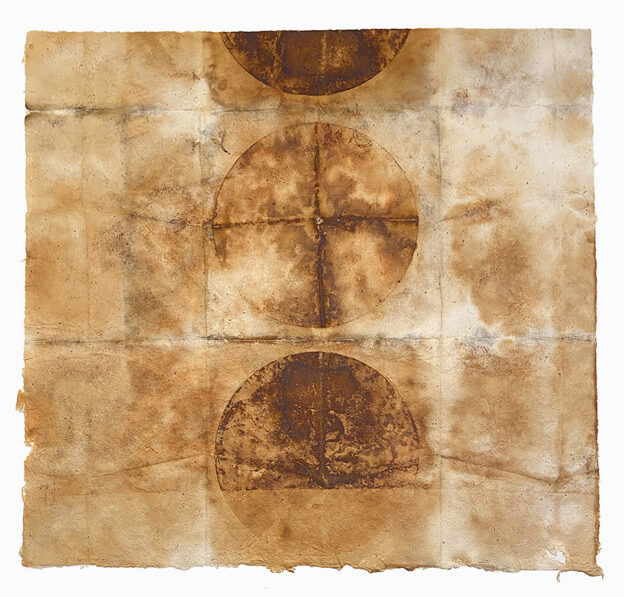
Christine Corday. Relative Points, Unfolded Object, EV 2 of 6. 2024. Oxidized Iron on Paper 28 x 28 inches. Photo: Corday Studio.
If there is such a thing as mathematical intuition (whatever its source and however it works), might there be a kind specific to visual art? Here the materialist hypothesis seems especially apposite, for visual art is above all a sensual medium. Artists work with bodies – their own and those of their materials – and are engaged foremost in physical processes. Given this material orientation, we can imagine that a kind of intuition specific to our field would be exactly opposite the one claimed by Gödel – that it would be, in other words, radically embodied. In a particularly memorable moment in Drawing the Passing, the excellent documentary about the artist William Kentridge, Kentridge gives us an example of what this might mean. Recounting an experience he had while working on one of his animations, he tells of having run into a problem with the visual narrative. From one scene in which a character is brewing coffee in a coffee plunger Kentridge had to find a seamless way to move to a scene in an underground mine. He tried one thing, then another – charcoal and hand moving over paper while he paced back and forth before the drawing – but nothing he drew seemed the right solution. Then, still drawing, he was struck by an intuitive hunch. Without knowing why, his gaze kept returning to the coffee plunger. For a while he ignored it, but the feeling persisted until suddenly the solution came, fully intact: If the character in the first scene kept pushing the plunger – down down down, past the bottom of the carafe and through the floor (remember, this is animation) – the plunger could keep traveling until it reached the mine, delivering the viewer to the new scene without rupture. It’s a brilliant moment in the film, and one made all the more so by Kentridge’s insightful commentary. What he only mentions cursorily, however, is the role of his body in solving the problem – that it was the very process of moving hand, eye, and body that seemed to deliver the needed insight. In the context of what we’re exploring here, we might surmise that, with his whole being concentrated on the vertical nature of the problem (i.e., how to move from up to down), his eye caught the vertical structure of the coffee plunger, and, his body moving against the downward pull of gravity, his unconscious imaginatively put the two together: vertical plunger plus downward pull equals – eureka! – leaving only for his unconscious to signal for his attention, which it did, of course, with the feeling in the gut and insistence of the returning gaze.
As artists, we’ve all had some version of this experience, where a problem is solved intuitively in the doing. But there is a deeper dimension to intuition in art – deeper than its role in the vicissitudes of making. This is the question of its relation to truth. Truth is something few artists dare entertain today, postmodernism having done away with absolutes absolutely. But in light of the present hypothesis, it may well be time to resurrect the word. For if intuition is a function of our body’s reciprocity with other matter, and if the body is capable of exquisitely subtle sensing, is it such a stretch to imagine that some of our intuitions might reflect the very nature or structure of the world? One thinks of Lucretius and the Epicureans who, thousands of years before atomic science, postulated a world made of invisible atoms. Clearly not obtained through conscious empirical means, this knowledge can only have come to them intuitively. Might there be a sense in which our bodies feel nature’s structure, registering it as percepts deep in our sensorium – percepts that, in gifted people, can make their way into consciousness?
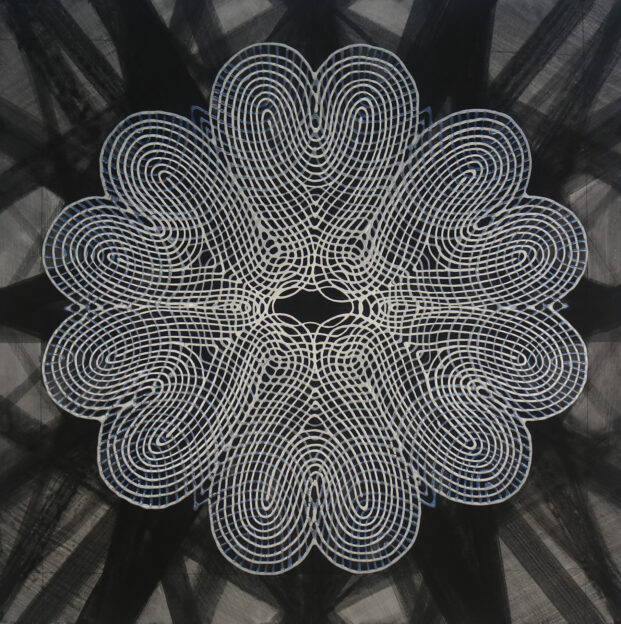
Daniel Hill, Untitled 2, 2019. Acrylic and acrylic polymer emulsion on panel, 24″ x 24″. Photo: Daniel Hill.
The implications for abstract art here are particularly momentous. For in abstraction especially is subjectivity presumed; why a square placed just so works while the same square nudged slightly leftward does not is assumed to be a matter exclusively of the artist’s taste. One placement simply accords better with her sensibility. And the same goes for why she’s drawn to squares in the first place – or to waves or certain reds or amorphous fields. But if the faculty making these decisions is intuition – and this is certainly what most artists would say it is – might we be responding not to subjective preference but to something we’ve perceived out there in the world? Might our bodies be drawing on their intelligent sensing while our minds are adjudicating based on what they have gathered? Consider the greatest art – art with real gravitas. I think of Ad Reinhardt and those luminous rectangles that send so many people into aesthetic rapture. Perhaps there is something about those shapes, about the nature of their arrangement and the compositional forces they enact, that echoes some truth only our bodies can know. In Reinhard’s case, I’m willing to state it definitely: truth dwells there. That my claim could never stand against reason’s interrogation seems scant reason not to make it, and scanter still not to feel it.
Yes, but… Anyone who’s made it this far will doubtless be left with a nagging question. Even if we’re willing to take intuition seriously, and even if we allow that it might have access to deep truths, how are we to know which intuitions are profound and which are trivial or downright wrong? The truth is that we cannot know with certainty, now or probably ever; the best we can do is rely on our keenest judgment and trust in our convictions when they seem to warrant it. Lest this leave anyone crestfallen, a man living in Vienna once had something to say about this. For there in the darkness where he lay receiving, Gödel had an insight that would extend beyond mathematics. Collapsing his field’s dreams of a purely rational world, the insight proved, through deductive reason, that reason itself is necessarily limited – that there not just are but indeed must be truths about the world that we cannot know by rational means.[3] Whether by metaphysical speculation, Gödelian intuition, or any of our other non-deductive means of knowing, art among them, we can and must learn of these truths supra-rationally. If this irks us today in our certainty-seeking world, imagine what it did to Gödel’s colleagues at the time (think apoplexy, followed only by begrudging acceptance).
Where, then, does this leave us as artists? Does this mean we should throw discursive reason to the wind and devote ourselves only to intuiting deep truths? No, it does not, for we will always need both powers. What it does suggest, however, is that we should do some reflecting. We might begin by asking ourselves why we rejected intuition in the first place and whether there might not lie beneath those reasons some deeper source of our discomfort. For in recalling our old assumptions about what intuition is – about its speaking exclusively of and from our selves – we may find that it is not intuition per se but rather subjectivity that sits uneasily. In a culture in which art is considered “merely subjective” and therefore, by implication, irrelevant to world affairs, the very word holds a charge that justifiably chafes. It may well be that art’s pivot toward discursive reason has been a reaction born of insecurity – a bid to prove our worth by way of association with a reigning power. But even more fundamentally, subjectivity itself may be giving us pause. For if the materialist hypothesis holds any truth, the idea of a purely subjective self is betrayed as a piece of fiction we have only ever imagined. Our bodies in ceaseless dialogue with the sensible world of other bodies, all the world a cosmic chorus of interaction and exchange: how could there be such a thing as a self-contained anything? Would it not be more accurate to conceive of ourselves as mutating multiplicities, or as open, ever-shifting, kaleidoscopic constellations? Subjectivity is an idea that holds no truth. We know this not because we have read it, here or elsewhere. We know this because we have felt it, deep in our bodies. For a long time now we have known it, all the while knowing without knowing how or why we know.
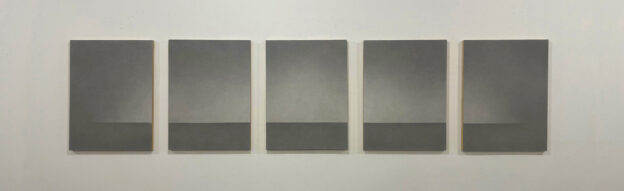
Taney Roniger, Broken Horizon, 2024. Graphite and charcoal on paper mounted on panels, 6 panels, each 24″ x 18″. Photo: Concatenations.org.
………………………….
Footnotes
- As anyone who’s read McGilchrist knows, all of his current research is an elaboration of his new theory of the human brain, specifically of its bihemispheric structure. For him, intuition is one of the prized functions of the beleaguered right brain, whose way of experiencing the world is being eclipsed by an overly dominant left. Because it is difficult to discuss the subject of hemispheric differences without invoking the old, and now thoroughly discredited, theory, I am leaving McGilchrist’s larger framework out of this discussion. I urge anyone who’s curious to read his books post haste; what he has to say on the subject is as original as it is convincing.
- The cultural anthropologist Edward T. Hall writes of similar findings in his studies of proxemics. In one notable instance, he tells of a psychiatrist who could know what his patients were feeling long before the patients did. Using his keen introspective skills, the doctor determined that the information was being transmitted to him olfactorily; as the patients’ feelings shifted, their bodies emitted chemicals that the psychiatrist was able to smell, and, equally remarkably, to interpret correctly – all of it unconscious and only brought to consciousness after laborious reflection.
- This insight would form the basis of Gödel’s now-famous Incompleteness Theorems, the technical details of which, while fascinating, don’t concern us here.
………………………………………………
https://www.concatenations.org/
All images copyright and courtesy of the individual artists
Get the Full Experience
Read the rest of this article, and view all articles in full from just £10 for 3 months.
No comments yet.