Inner Space. Outer Space. (II)
Issue 67 September 2021

Contemplating Complexity
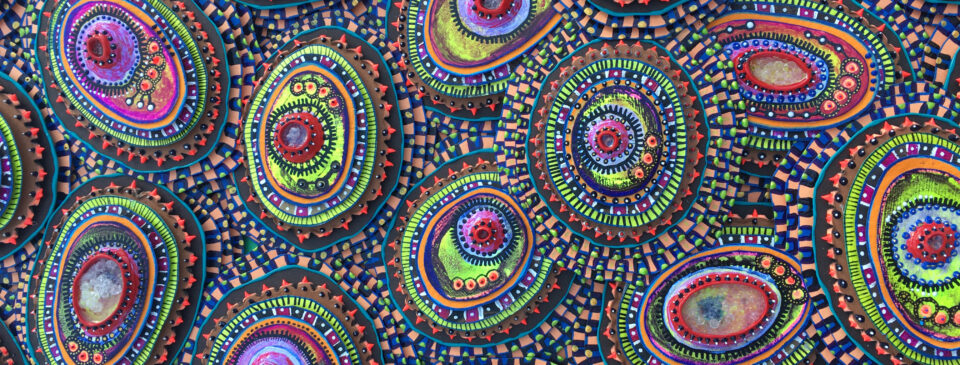
“Complexity is the underlying focus of my work. My work is not rigidly representational but rather it’s suggestive of the very real and very complicated parts and systems that compose and surround us but that cannot be seen by the naked eye. Using motifs from microbiology, I experiment with material, scale, and replication to create abstract biomorphs of vivid color, hyper-texture, and dedicated detail.”
Drawing on her experience with ceramics, fabric, and sculpture, Amie Esslinger’s paintings and distinctive mixed-media installations attempt to bridge the gap between art and science.

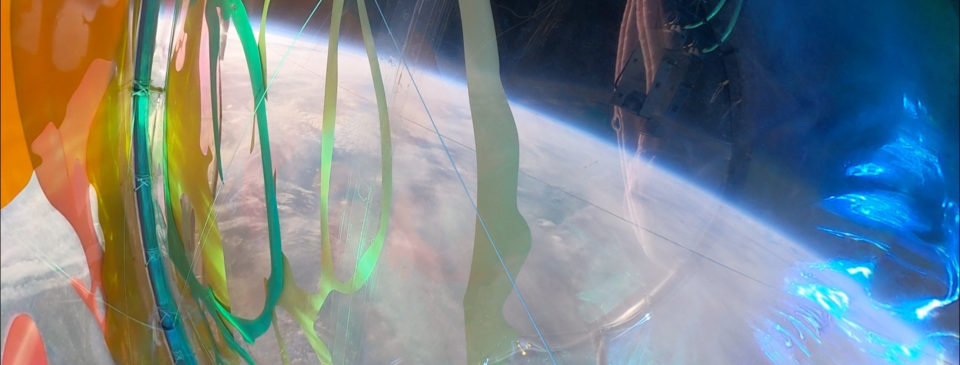
Living Light
Living Light is an artwork designed by the Beyond Earth artist collective for spaceflight. It combines biology, artificial intelligence, and aerospace technology. Living Light explores the connections between our blue planet and the boundlessness of outer space. Beyond Earth modeled the design to nest within Spaceship Neptune, referencing the Roman God of the sea. Its form was inspired by the vast biodiversity of aquatic life on Earth.. The artwork traveled to space on June 18 2021 aboard Neptune One, Space Perspective’s inaugural test flight.
Connecting the Microcosm and the Universe
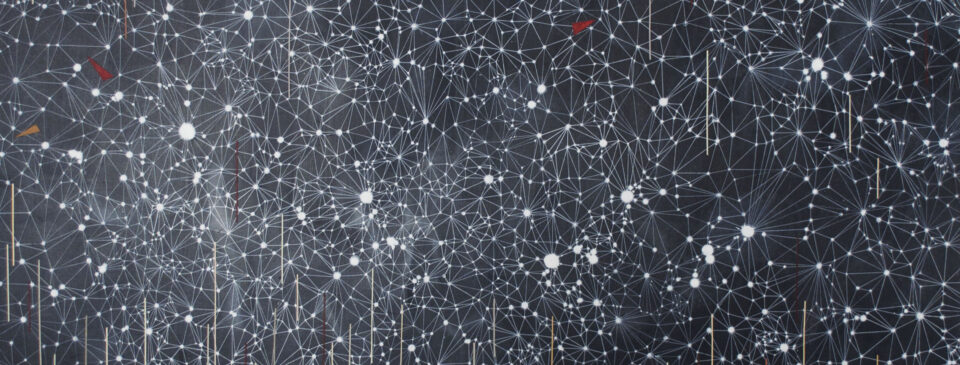
Seiko Tachibana’s distinctive work balances Asian tradition with minimalist modernity, with works having a poetic beauty that explores the essential patterns of life. She creates images that suggest both a world in microcosm as well as the immensity of the universe. A recurring theme in her work is “the ways in which many small pieces come together to make up a larger whole,” and how modular and accumulating forms can create structures and dynamics.
Analog Astronaut
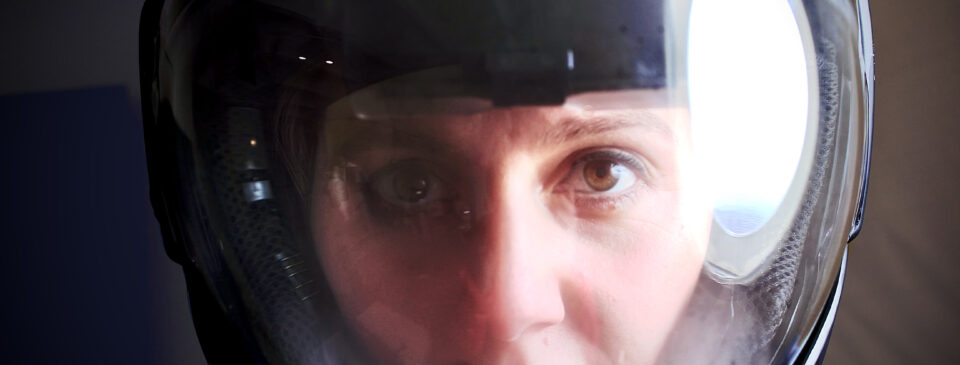
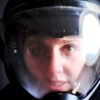
Richelle Gribble is an expeditionary artist exploring planetary connectivity, both on and off Earth. Her work explores connectivity in a world where human impact, technology, and the environment collide. She has completed 18 art residencies as part of her project The Nomadic Artist, where she travels the world to reflect social and environmental changes across the globe. She is an Analog Astronaut and Head of Creative Research for analog space missions on the Moon and Mars via Hawai’i Space Exploration Analog and Simulation (HI-SEAS), Sensoria Program, and Lunares Research Station.

Dark Matter and other poems
Lynne Goldsmith’s first book, ‘Secondary Cicatrices’, won the 2018 Halcyon Poetry Prize, was a 2019 Finalist in the American Book Fest Awards, a 2020 Human Relations Indie Book Award Gold Winner and won a new Finalist Award in the International Book Awards. Her poetry has been published in Backchannels Journal, Spillway, Thimble Literary Magazine, Environmental Magazine, Red Planet Magazine, among others, with upcoming poems in Tiny Seed Literary Journal and Scotland’s 2020 Geopoetry Conference program. Her poetry book ‘Secondary Cicatrices’ recently won a Book Excellence Finalist Award.
A quantum hack for microscopes can reveal the undiscovered details of life
Warwick Bowen is Professor of Quantum and Precision Technologies, The University of Queensland. He earned a PhD in experimental physics from the Australian National University in 2004 for his work on quantum information technologies. He is currently a professor of physics at the University of Queensland. His research interests center on the development of precise measurement techniques based on quantum science, and their application in areas such as biological imaging, precision metrology, and advanced sensing. Prof Bowen leads the University of Queensland Quantum Optics Laboratory, is Director of the University Precision Sensing Initiative, and is a Theme Leader of the ARC Centre of Excellence for Engineered Quantum Systems. He is also a founder and Director of Elemental Instruments, a company that develops, manufacturers and sells precision scientific instrumentation.

Could Schrödinger’s cat exist in real life? Our research may provide the answer
Stefan Forstner is Postdoctoral Research Fellow, The University of Queensland.
“I work on quantum physics and on precision sensing, both in theory and experiments.”
Is it time to give up on consciousness as ‘the ghost in the machine’?
Peter Halligan is currently Hon Professor of Neuropsychology at Cardiff University and Chief Scientific Advisor to the Welsh Government .
Following training in psychology and philosophy at University College Dublin, and 14 years in the Departments of Clinical Neurology and Experimental Psychology at Oxford University he moved to Cardiff in 2000
Awarded the British Psychological Society’s Presidents’ Award for outstanding contributions to Psychology in 2005, he is a Fellow of the British Psychological Society, Irish Psychological Society, Royal society of Biology and Academy of Medical Sciences . He was co-editor of the Cognitive Neuropsychiatry.
David A Oakley is Emeritus Professor of Psychology, UCL and Honorary Professor, School of Psychology, University of Cardiff.
“My earliest research was into the cortical and subcortical substrates of learning and memory (primarily in the context of Pavlovian conditioning and instrumental learning). More recently I have been interested in hypnosis and suggestion as topics in their own right, as therapeutic techniques, as a means of exploring pain, consciousness and the voluntary control of action, and in the creation of experimental analogues of clinical conditions, such as conversion disorder and functional pain.”
Fellow of the British Psychological Society. Fellow of the Royal Society of Medicine, Editorial Consultant: International Journal of Clinical and Experimental Hypnosis. Associate Editor: APA Psychology of Consciousness: Theory, Reasearch and Practice.
A thread of the cosmic web: astronomers spot a 50 million light-year galactic filament
Ray Norris is a British/Australian astronomer in the School of Science at Western Sydney University, and with CSIRO Astronomy & Space Science. He researches how galaxies formed and evolved after the Big Bang, and the process of astronomical discovery with large data volumes. He also researches the astronomy of Australian Aboriginal people.
Ray was educated at Cambridge University, UK, and moved to Australia in 1983 to join CSIRO, where he became Head of Astrophysics in 1994, and then Australia Telescope Deputy Director, and Director of the Australian Astronomy MNRF, before returning in 2005 to active research.
He currently leads an international project – the Evolutionary Map of the Universe – to image the faintest radio galaxies in the Universe, using the new ASKAP radio telescope recently completed in Western Australia. He also leads the WTF project which is exploring machine learning techniques to discover the unexpected.
He frequently appears on radio and TV, and has published a novel, Graven Images.
Can the laws of physics disprove God?
Monica Grady CBE is a leading British space scientist, primarily known for her work on meteorites. Since 2005, she has been Professor of Planetary and Space Science at the Open University, and is currently Head of the Department of Physical Sciences.
Prior to 2005, Grady was based at the Natural History Museum in London, where she curated the UK’s national collection of meteorites. She graduated from the University of Durham in 1979, then went on to complete a Ph.D. on carbon in stony meteorites at Darwin College, Cambridge in 1982. Since then, she has built up an international reputation in meteoritics, publishing many papers on the carbon and nitrogen isotope geochemistry of primitive meteorites, on Martian meteorites, and on interstellar components of meteorites. She gave the Royal Institution Christmas Lectures in 2003, on the subject “A Voyage in Space and Time”. Asteroid (4731) was named Monicagrady in her honour.
Grady was appointed Commander of the Order of the British Empire (CBE) in the 2012 Birthday Honours for services to space sciences. She is the first UK scientist to be President of the international Meteoritical Society.