Emerging Ideas
Martha Gray: BioCyan
Martha Gray is a London based artist and curator, who has worked with alternative processes for the past seven years. Gray’s practice explores personal relationships to the ‘natural’ through experimental photographic processes, with ongoing research into the use of cyanotype as a contemporary method.

Martha Gray: BioCyan
The series BioCyan is the result of an exploration into the canon of photography, and alternative process photography’s place within it. I have been working with cyanotype as my primary medium over the last five years, with a consistent focus on chemical intervention to create a contemporary interpretation of the historical process. In April 2020 I began my experimentation with inserting bioplastic technology into cyanotype with the intention of creating a more sustainable, paperless and, gelatine free photographic print. I chose the algae based agar as my bioplastic medium, and
once the application to cyanotype was made it became apparent the intrinsic connection my practice has to the legacy of Anna Atkins and her seminal work Photographs of British Algae:
Cyanotype Impressions, the first photographically illustrated book. As I experimented, I began to question why I hadn’t felt drawn to researching Atkins before. This questioning became the catalyst for my MA Art and Science research thesis, which looked critically at the canon of photography through the public and academic perception of Anna Atkins. The ‘othering’ of alternative
photography can be traced back to its connections to Victorian era ladies ‘craft’ work, and perceived notions of suitable pastimes for women being based in reproductive technologies. Once Atkins completed Photographs of British Algae: Cyanotype Impressions it was gifted to peers in her academic circles, however the book was not published due to its creation by a women. Atkins’ work would not be published until the 1980’s after its rediscovery by Larry Schaaf while researching a different project. This came over a hundred years after Atkins’ death, and while
Atkins deserves all the influence she is given, it is still through a male gaze. The existence of the canon is still apparent today in the ‘othering’ of Atkins’ legacy. By working with cyanotype and as a female identifying artist, I am linked back to Atkins, and placed within the canon that holds the most influence today. The images depicted in BioCyan were shot in 2014 when I travelled to a beach in England, similar to where Atkins would have collected her Algae specimens. Using 35mm film I photographed the sand and water, and I have chosen these images to be printed on my bioplastic cyanotypes as a symbolic gesture. Inspired by Atkins innovative intersectional union of art and science, the intention of BioCyan is a personal reclaiming, and challenging, of the narrative controlled by the canon. BioCyan is the physical intervention of photography, by redefining what the physical possibility of the printed image can be.
The irregularity of the perfect imperfection in shape, texture, and size of my bioplastic cyanotypes with my sand and sea images create, with a sense of symbiosis, a photographic object that is a
depiction of its process. The cyanotype process has deep rooted connection to industry through its discovery by Sir John Herschel during the era of the Industrial Revolution, and use in the
production of the Blue Print. Cyan is one of the rarest colours to naturally occur in nature giving evidence to the cyanotypes syntheticity. Another process to arise from the industrial revolution is the mass produced disposable plastic. The process of bioplastic cyanotype is a combination of an industrial material and craft, but with the polarity of sustainability in intention. I’m interested in the notion of giving a material deemed so disposable as plastic in the public conscience, a sense of preciousness. My aim is to keep researching the possible sustainable properties of my bioplastic
cyanotype process. I am currently working towards simplifying my method of production to make my bioplastic cyanotype process an accessible paperless, and gelatine alternative in alternative photography.

Martha Gray: BioCyan, Sand
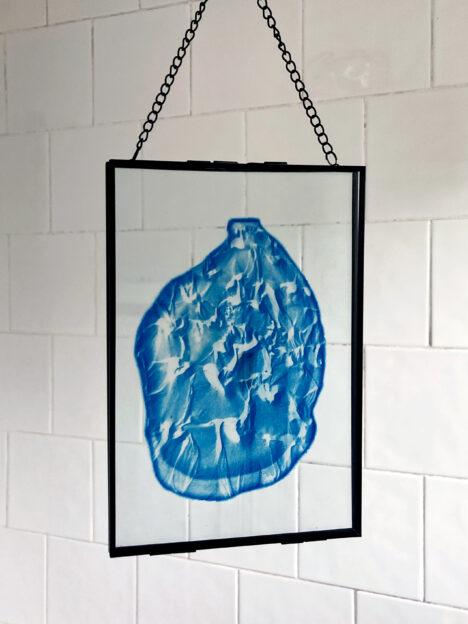
Martha Gray: BioCyan, Sand, 2 4x 17cm
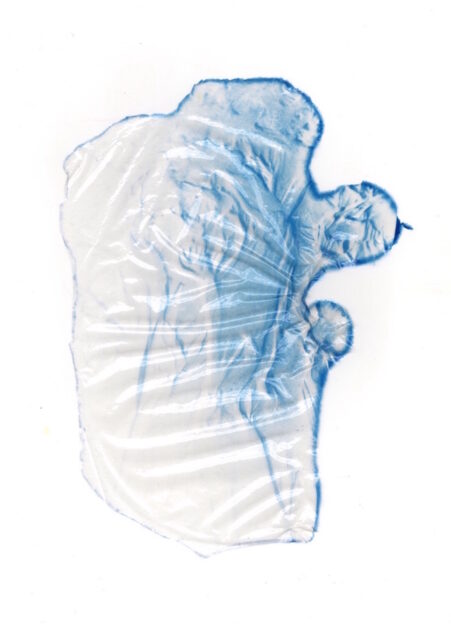
Martha Gray: BioCyan
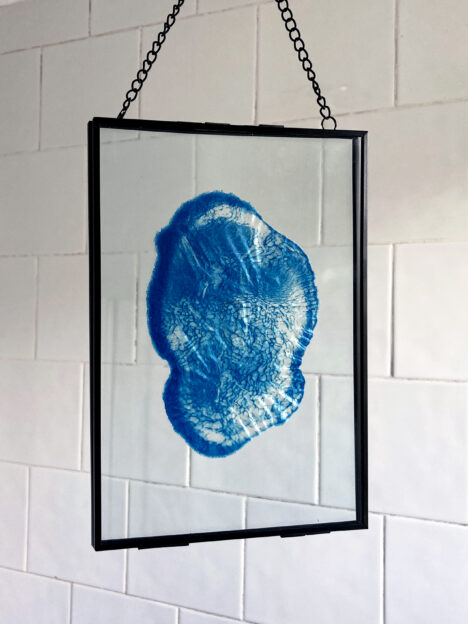
Martha Gray: BioCyan, Sea, 24 x 17cm
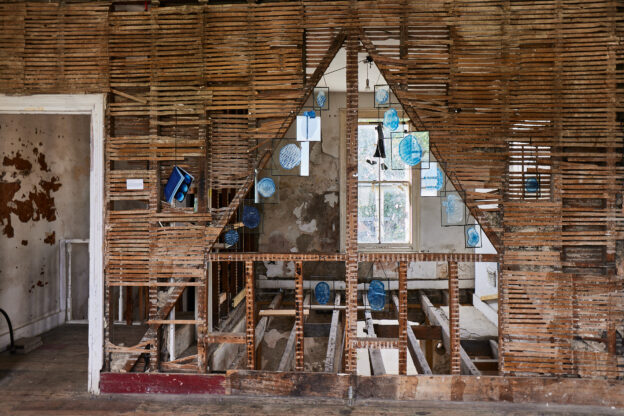
Martha Gray: BioCyan (installation)
Artist Statement
Martha Gray is a London based artist and curator, who has worked with alternative processes for the past seven years. Gray’s practice explores personal relationships to the ‘natural’ through experimental photographic processes, with ongoing research into the use of cyanotype as a contemporary method. Gray is a recent graduate of the MA of Art and Science at CSM, where they have been experimenting with and exploring bioplastics combined with cyanotypes. Inspired by the early history of alternative photography, Gray uses algae based bioplastics in homage to Anna Atkins and with the intention to critique the canon of photography. Gray’s previous research involved re-imagining the oxymel process through the introduction of FODMAP’s to cyanotype, as an investigation into the effect of antibiotics on the gut biome
Get the Full Experience
Subscribe today and view all issues in full from just £10 for 3 months.
Comments are closed.